Our daily bread

Lebanon, Lebanon making dough, but can’t catch up to what she owes
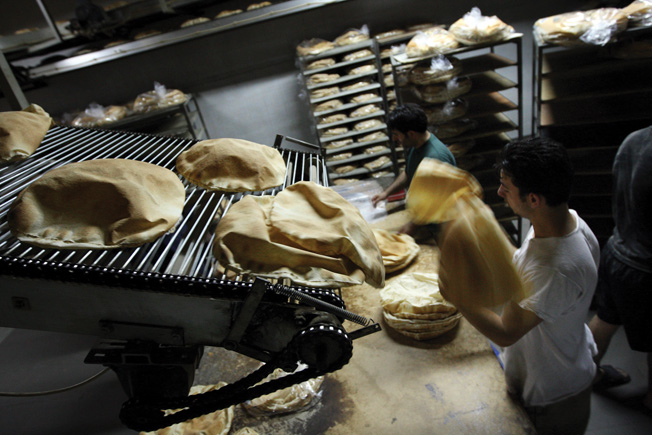
Prices of bread rose 4-fold in 2008 because of rapid inflation and increasing food costs (AFP)

Judging an economy solely by the numbers rarely reflects the situation on the ground, especially in Lebanon. In 2009, the country experienced an economic roller-coaster with gross domestic product growth estimates ranging from a pessimistic low of 2.4 percent at the beginning of the year — due to the perceived effects of the international financial meltdown — to the optimistic high-end estimate of 7 percent growth some were proffering by year’s end.
While growth of some sort was almost certain, the Lebanese economy is still vulnerable, especially when it comes to managing or reducing its gargantuan debt.

The greatest success story has been in the banking sector, which has seen a 21 percent rise in deposits from September 2008 to September 2009, reaching $92.2 billion, with total assets rising 16.6 percent to $109.9 billion in the first three quarters of 2009, according to the Association of Banks in Lebanon (ABL). Compare that figure to Lebanon’s GDP projection of $32.7 billion — according to the International Monetary Fund — and, considering that banks and governments around the world were reeling from a lack of liquidity, Lebanon’s situation at the end of 2009 is enviable.

Industrial devolution

But a banking sector alone does not an economy make. The high energy prices in 2008 had a knock-on effect for many in the industrial and manufacturing sectors, who finally threw in the towel in 2009. The most remarkable closure was arguably Uniceramic, one of Lebanon’s flagship manufacturers, which produced 82 percent of the ceramic tile market share in March 2006. The company went bankrupt in September after high energy costs, cheaper imports and being stripped of safeguard measures saw its margins plummet. One of the few companies listed on the Beirut Stock Exchange in its early days after the Civil War, Uniceramic was finally delisted once and for all in November 2009.
Another sector that has seen better days is the agricultural sector, not least because of the scandal that erupted late in the year when lax regulation led to poisoned fruit appearing on local market shelves. The issue prompted many agriculturalists to lambast the government for its lack of focus on a sector that is the main source of labor for much of Lebanon’s rural population.

While reliable figures are not readily available, the sector is estimated to be worth some $1.5 billion by those in the industry, and the Economist Intelligence Unit’s (EIU) latest figures, from 2007, put its share of GDP at some 5.2 percent. According to Bank Audi, Lebanon’s agricultural exports amounted to a meager $69 million in the first six months of 2009.

“The share of GDP that agriculture and industry hold is around 15 percent,” says Kamal Hamdan, economist and managing director of the Consultation and Research Institute. “It’s not at the heart of the club,” he adds, referring to the Lebanese government’s focus on other economic sectors such as banking, real estate and services.
The amalgamation of these two faltering sectors, industry and agriculture, may prove to be their salvation. The agro-industry sector has seen double digit growth in the past few years, as well as in 2009, according to Nabil Itani, chairman and general manager of the Investment Development Authority of Lebanon (IDAL), the governmental institution that promotes investment in the agro-industry sector and other “productive sectors.” Again, exact statistics are unavailable.

“We don’t have industrial, tourist or sectoral censuses. We don’t count the production in each sector,” laments Jad Chaaban, acting president of the Lebanese Economics Association (LEA) and associate professor of economics at the American University of Beirut.

Even without sector specific data, indicators show that the tourism sector has done exceedingly well and real estate held relatively stable in 2009 riding, respectively, the 2 million tourists expected to have visited Lebanon by year’s end and a constant flow of real estate investment from inside and outside the country. According to Byblos Bank, by October 2009, a total of more than 1.4 million tourists had arrived in Lebanon, an increase of 46.3 percent over the same period in 2008.

Real estate sales transactions over the year declined by only 3 percent to total 55,482 in the first three quarters of the year, according to the General Directorate of Land Registry and Cadastre (GDRLC). The figures are a marked decline from the 24 percent yearly growth in transactions from 2007 to 2008. The total value of transactions during the first nine months of the year reached $4.3 billion indicating a 6.4 percent drop over the same period in 2008. Be that as it may, the accuracy of these figures has been questioned by some who deem their source, the GDLRC, as susceptible to false declarations from real estate firms and other obfuscating elements.

Karim Makarem, director at Ramco, a Lebanese real estate advisory company, says that one reason for this is because many sales are made off-plan and don’t get registered until buildings are completed.
“Transactions may be done a long time before [they are registered],” he says. “So you might have a situation where the real estate market is very stagnant and the figures being released are ever increasing.”

An elusive formula
When all the figures are tallied, Lebanon’s real economy is expected to have recorded bumper growth in 2009, albeit less than the IMF’s figure of 8.5 percent seen in 2008. The real amount of growth, however, is a contentious topic in the country’s economic community. The latest figures from the IMF predict a total growth of 7 percent for 2009. However, according to Bank Audi’s  research department, the last GDP figures provided by the government are those from 2007.

“You have several problems with estimating GDP. Even the government accounts are not up to date because they run on arrears,” says Chaaban. He predicts that 5 percent GDP growth is a more accurate number considering that “too few companies report their accurate figures. Even when it comes to real estate registration, hardly anyone puts in the right figure. You end up with a system of estimation and not accurate measurement.”

Much of the debate over the country’s accurate GDP centers on methodology. According to Hamdan, the government is currently using the French National Institute for Statistics and Economic Studies’ (INSEE) methodology to calculate GDP. This method offers three different ways to calculate GDP (see box on next page) and uses several parameters that cannot be calculated if sectoral or income-based reporting does not exist or is indeed inaccurate.

“Unfortunately we have no surveys which confirm the situation at the level of the economic sector,” says Hamdan.
The difference in methodologies has prompted organizations such as the EIU to maintain an estimation of 5.1 percent real GDP growth in 2009 as of end-October.

Marwan Iskandar, economist and managing director of MI Associates, however, agrees with the 7 percent IMF estimate made in early October, saying that the figure is not  just down to a bumper tourist season and real estate investments.

“The financial crisis had a beneficiary effect on the Lebanese economy because many Lebanese felt that their money abroad was not that safe, brought it back and are now looking at possibilities,” he says.
Iskandar’s point is substantiated by the fact that recent remittance figures have allayed fears of a decline in non-resident inflows to the country. According to the IMF’s most recent projections, Lebanon will attract a total of $7 billion worth of remittances in 2009, registering a contraction of only 2.5 percent on the previous year. According to Hamdan, some of this is a result of assets being liquidated by non-resident Lebanese, which could result in this phenomena being a one off.

The prognosis of many experts however, is that remittance levels will remain relatively stable in 2010, as the global economy is expected to see some kind of recovery and Lebanon has not seen the massive influx of expats from the Gulf that were expected due to the global downturn.

“There was a presumption that there was going to be massive unemployment in the Gulf and the reality was that while growth was stunted, massive unemployment was not created,” says Rabea Ataya, chief executive officer of Bayt.com, one of the largest recruitment firms in the Middle East.

The increased non-resident interest in Lebanon is also reflected in the growing amount of foreign direct investment in the country. In 2008, FDI reached $3.61 billion, according to a statement made by the United Nations Conference on Trade and Development, and is expected to hit $4 billion this year, says IDAL’s Itani.

Certain elements of Lebanon’s investment climate helped as well, such as the number of procedures needed to start a new business, which remain at five, lower than the Middle East and North Africa’s average of 7.9, according to the World Bank’s “Doing Business Report.” The report also stated that the time needed to complete these procedures had decreased from 11 to nine days in 2009 compared to a regional average of 20.7 days.

Despite the increasingly friendly investment environment, legal recourse in the country remains an obstacle for investors, because of Lebanon’s infamously tedious litigation process and inefficient judiciary.
“For the last 10 years, investors have depended on arbitration [instead of judicial process]. This is a solution because time is money,” says Itani.

As Executive went to press, the Court of Accounts — the judicial body responsible for Lebanon’s Financial Court — had not yet submitted its annual reports for the years 2006 to 2008. Neither had it appointed a new president. The president’s post has been vacant since 2007.

Moreover, the special economic zone in Tripoli that was slated for construction at the end of 2008 was not created, although Itani expects it will be completed by the end of 2010.

Balance it out
One thing the Lebanese economy can also count on is a large and positive balance of payments (BOP) boosted by inflows of remittances, non-resident investment and a positive net increase in the foreign assets of the central bank.
According to the ABL, the first nine months of 2009 saw the BOP come in at a record $4.84 billion with the trade deficit narrowing to reach $952 million in September. Speaking at the Union of Arab Banks annual conference in November, Central Bank Governor Riad Salameh even stated that the balance of payments had reached $6 billion in October.

That bloody debt
As for public finances, there has been little progress. Lebanon’s gross public debt, which is held in most part by local commercial banks, continues to mount and is expected to reach $50.46 billion by the end of 2009, according to Byblos Bank projections. The cost of interest payments on the debt is the heaviest burden the government carries. According to Lebanon’s finance ministry, debt servicing amounted to $2.91 billion in the first nine months of 2009 alone, well on its way to the 2009 budget’s target of $4 billion for the year. That budget, released in August 2009, is just a proposal, however, and has no legal bearing since no budget has been ratified since 2005 by the Lebanese Parliament.

Iskandar predicts that the final amount of debt for the year will come to around $4.4 billion, but he insists the situation is not “destitute” except when it comes to political decisions.

“The government can do something about it [the debt] but they don’t because the political system is based on clientelism and nepotism, not achievement or performance,” he says. Still, Iskandar believes that the situation is better than the numbers suggest, because 83 percent of the debt is held by both Lebanese individuals and institutions that have an interest in continuing to hold this debt, because “it pays rates that you don’t get anywhere else in the world.”

According to Byblos Bank’s estimates, return on Eurobonds ranged between 7.25 percent and 7.35 percent in November 2009. “As long as they are getting their interest and the principal is being paid by issuing [more instruments]…they don’t want to unload because they are earning,” says Iskandar.

Some even suggest that the real burden of the gross public debt is much less than the expected 154.3 percent of GDP projected by Byblos Bank at year’s end. The IMF says that if the government continues to enact “unchanged policies” the ratio could decrease to 151 percent by the end of the year.

Shortage and spending
Even if the country is not on the verge of financial collapse, the real problem of the debt is that servicing it does not allow the government to close the “black holes” that absorb so much of its current spending. The public electricity company, Electricité du Liban (EDL), is a case in point, as it is expected to drain some $1.5 billion from government coffers, according to Mohamad Chatah when he was finance minister in 2009. In the first three quarters of 2009, the government had already spent $1.16 billion on EDL, according to the finance ministry. The budgeted amount to be spent on EDL in 2009 was $1.23 billion, which will likely be overshot by the end of the year.

Most of EDL’s expenditure continues to be allocated to fuel oil imports that are shipped instead of piped, causing them to be even more costly. In September 2009, after repeated delays over issues relating to pricing and quantity, Lebanon began to receive cheaper and more environmentally friendly natural gas piped from Egypt via Syria to run its power plants. The agreement spans 15 years and stipulates that Egypt will supply Syria with 250 million cubic meters (mcm) of gas every year. In turn, Syria will pass on an equivalent amount to Lebanon whose total should eventually increase to 600 mcm per year. In total, the gas is expected to save Lebanon around $240 million based on an oil price of $75 per barrel, according to the investment bank EFG-Hermes, which also owns a minority stake in Bank Audi.

“It’s good to take gas from the Egyptians because the Syrians cannot interfere with it. This is a multilateral agreement and that is the only reason why we received the gas,” says Iskandar.

The agreement is renewable by mutual consent with pricing renegotiated every three years, meaning that the gas is seen as more of a non-stick band aid than a stitch-up for Lebanon’s electricity finances.
“If the Egyptians suddenly don’t like us, they will shut off the gas,” says Chaaban.

In the short to medium term, the government looks set to implement former energy minister Alain Tabourian’s plan of buying smaller generators, which will cost around the same as the amount the government saves from using Egyptian gas. The agreement comes after months of political quarreling over the issue between the ex-minister and former Prime Minister Fouad Siniora. The generators are expected to produce 300 megawatts of electricity, slated to begin operations in the summer of 2010 during the months of the year when electricity consumption peaks.

Gas in hand, the Lebanese government will have some room to maneuver on the electricity issue. However, to make up much of the lost ground, the government will have to enact reforms, such as remote meter reading to replace the “1,900 people who come to measure your meter,” says Iskandar.

Another option is to increase costs of electricity to consumers, given that 38 percent of electricity in Lebanon is generated by private generators, according to Iskandar, and are much more expensive than state-provided electricity.
The proposal seems to be a sound one, according to Hamdan, who says his firm conducted a survey of 2,500 households in Lebanon, the majority of which stated they would be willing to pay higher prices if they were guaranteed 24-hour a day electricity. According to Hamdan, the sector itself will take about five years to reform if the government is serious about undertaking the task. Time looks to be of essence since he also states that electricity consumption is rising at around 10 to 15 percent a year.

A social insecurity
Another state-owned entity that is draining government finances is the highly politicized National Social Security Fund (NSSF). Iskandar, who previously consulted the government on how to reform the fund, says the NSSF is “cancerous and is not going to improve.” There are no reliable figures that detail the government’s liabilities to the fund. One chief executive officer of a Lebanese bank who spoke off the record stated that in the lead up to 2009, the NSSF’s records had not been audited for eight years.

“It is facing a crisis. They are spending money without accounting for it,” says Chaaban.

The 2009 budget proposal bluntly states, if only in small print, that, “NSSF dues have been paid by the Ministry of Finance in previous years but these amounts were not allocated in the national budget.”

Media reports have suggested that the fund is running a deficit of around $456 million and Chaaban states that only 35 percent of workers are registered in the fund because many employers and employees choose not to register. Another statistic that points to the fund’s inefficiency is that government spending on public health was estimated at 12 percent of total spending, or $820 per capita, while Syria spent only $110 per capita and Jordan $500 per capita in 2005, according to the 2009 UN Arab Human Development Report. Spending on health and the NSSF are accounted for separately in the 2009 budget proposal.

Spending without fixing
The central bank has been swapping short term debt for long term debt to maintain the semblance of financial stability. At present, the Banque du Liban has succeeded in “buying time,” as Hamdan puts it.

Time, however, does not seem to be a luxury the Lebanese government can afford, as it has to budget for an increase in expenditure of 42 percent, or $10.82 billion, even with a budgeted spike in revenues of 36 percent, or $7.55 billion. As Executive went to press, total budget deficit in the first three quarters of 2009 had reached $2.22 billion. As such, it seems highly likely that the budget deficit target of 10.6 percent of GDP set for the Lebanese government by the IMF, could well be met.

Notwithstanding the fact that the government has to bear the burden of interest payments on the debt, the NSSF, EDL and other expenditures, it still ran a primary surplus of $693 million in the first three quarters of 2009 and budgets for $746 million by the end of the year. The government is still using the budget of 2005 as a baseline, according to Chaaban, by allocating what is overspent to the next year; but without the interest payments on the debt, the government would in fact be profitable.

Promises, promises
The Lebanese government has few options to get out from under its mound of debt. It will have to make several political decisions, including those related to the Paris III commitments, the enactment of administrative reforms and privatization of key state-owned enterprises such as telecommunications and electricity, to garner enough revenue to pay off at least some of the debt in the hopes of having it reach a manageable level.
With new finance minister Raya Haffar stating that she will pursue Paris III commitments, there is renewed pressure to enact many of the initiatives proposed. According to the finance ministry, $5.7 billion worth of Paris III pledges have been signed as of end-September 2009, with disbursements increasing by $600 million from April to November 2009.
Paris III’s planned initiatives are expected to be opposed by many — from the parliamentary opposition to local commercial banks.

“The terms were negotiated in a different political atmosphere,” says Iskandar, in a reference to the former Rafiq Hariri government that drew up the initial program. “I don’t think there will be any progress because politically it is not feasible.”

Indeed, considering recent proposals, changes appear unlikely. Increasing the value added tax (VAT) to 12.5 percent is highly unpopular amongst the parliamentary opposition and will require a new law to be drafted and passed. Hamdan says that between 1998 and 2008 the average national wage has increased by only 20 percent, and cumulative inflation by 80 to 90 percent. Thus, he says, it is doubtful that an increase in VAT is possible in the near future.

“I know most of these ministers and I don’t think they will sign onto this approach,” he says.
With the threat of inflation looming because of a falling dollar and rising oil prices, this possibility seems even less likely to be popular with the wider public. Officially, the consumer price index registered at 106.7 in September 2009, according to official figures. Chaaban has little faith in official figures since, he says, a useful methodology was only recently adopted.

“They used to count only Beirut and the basket was not representative of the actual consumption pattern. At some point even housing was not included,” he says, warning that inflation, while steady in 2009, could rise by at least 5 percent in 2010.

While this figure is much less than the rates experienced during the oil boom of 2008, Chaaban says the phenomenon of asymmetric transmission, whereby prices go up but don’t come down, continues to affect Lebanon’s consumers. Even according to official figures, which use December 2007 as a baseline, CPI for the items with some of the highest weights such as housing, food, beverage and transportation have all risen by more than 10 points as of September 2009.

This may not bode well for those keen on implementing the global income tax, for which a draft law currently exists, making it more “possible that it might be implemented with some changes,” says Chaaban.
Increasing taxation rates from 5 to 7.5 percent on interest earned from banks also seems to be a highly unpopular move with many local banks that hold much of the public debt and thus have considerable political influence.

“If there is no reform, the banks will be reluctant to go in this direction,” says Hamdan. The only Paris III earmarked requirements that seem likely to continue are those associated with reforms in the public sector, from which Chaaban believes the government can only receive around $1 billion to reform EDL in 2010.

The only other option seemingly available to decrease the debt is to privatize the telecom and electricity industries. The former looks set to remain a contentious issue between the various national and international players who have diverging opinions on whether the sector should go private or stay public.

“I think that the minister of telecommunication will defend increasing the assets [of the telecom industry],” says Hamdan, in reference to the proposal to increase the assets of the telecom sector by improving its current infrastructure and selling it off at a higher price. That may well prove to be an arduous task if the telecom ministry’s operations continue to be politicized. “Selling it in this form amounts to giving the investor the current structure of prices and revenues, so you are essentially securing the flow of hidden taxes,” says Hamdan, who supports this proposal.

Others, however, disagree. “The sector is not going to move in the right direction without really having momentum from the private sector,” says Kamal Shehadi, chairman of the country’s Telecom Regulatory Authority. “By that I mean all of the economic associations will have to get on board.”

And given the track record of public ownership, his sentiments are echoed by many consumers who are tired of having some of the highest telecom costs in the world.

As Executive went to press, a ministerial policy statement had yet to be approved by the Council of Ministers. Expectations are that it will closely resemble the previous statements adopted by the past two governments.
There is still a sense of optimism that the new government ministers can overcome some of the economic hurdles, even if they will have to fight over details in the process.

“They are not politicians that are there just to oppose each other. Even if they oppose each other they will reach a compromise, as they are technical people who can discuss things,” says Chaaban. “Because the government took so much time to form I think now everybody is expecting it to deliver.”

First published in Executive Magazine’s December 2009 Lebanon issue

Sounding the alarm

Debt freeze leaves global markets howling

by Sami Halabi and Emma Cosgrove

Duabi's man-made islands were just one of the many projects that Duabi World borrowed a still unspecified amount to build (AFP)

Common sense is the currency of rational minds — in this respect Dubai may be short on change. On November 25, Dubai World, the wholly owned subsidiary of the Dubai government, announced that it would request a 6-month standstill on all payments and debt servicing of some $11 billion due to creditors in December — effectively giving notice that the further $49 billion the company has outstanding may also be beyond its means.

The announcement came after the markets closed for the four-day Eid al Adha holiday, during which time the company maintained complete silence while the news shook the financial world, prompting panicked investors to line up at the doors of Gulf markets to dump exposed portfolios when bourses reopened on November 30. As they waited in the Gulf, financial markets from London to Beijing shed share value in fear of their own exposure.

Dubai and Abu Dhabi markets dropped instantly at the opening bell, followed closely by other regional markets. The next day, Dubai World released a statement confirming it was in talks with United Arab Emirates banks to restructure $26 billion in debt. The company said restructuring could consist of “deleveraging options,” “asset sales,” and “formulation of restructuring proposals.”

“We would expect a decision to come out of [the discussions]  on what assets underlay the liabilities, and what the plan is for liquidizing those assets so that bondholders get some partial repayments,” said Raj Madha, director of equity research at EFG-Hermes.

As executives and Dubai authorities prioritize Dubai World’s obligations behind locked doors, the rest of the financial world can do nothing but wait and watch the markets.

The markets react
By the middle of November 2009, the financial world seemed optimistic — and with some justification. The Morgan Stanley Capital International (MSCI) index had recovered 48.9 percent of losses incurred during the downturn, while the MSCI Emerging Markets index had fared even better, recovering 58.13 percent. The MSCI Arabian Markets index — Gulf Cooperation Council, Egypt, Jordan, Morocco, Tunisia and Lebanon — also followed suit, albeit with a little less vigor, recovering 30.89 percent of their losses.

After the announcement that Dubai World could effectively not pay its debt on time, that recovery quickly went into regression. In just two days of trading the Dubai Financial Market (DFM) dropped 12.5 percent and the Abu Dhabi Stock Exchange fell by 11.6 percent. Dubai’s indices for real estate, as well as investment and finance, saw some of the worse losses, down 18.1 percent and 15.5 percent respectively.
The fallout from the Dubai World announcement is expected to send foreign investors’ capital looking for economies with lower risk factors. This will almost certainly have an adverse effect not only on public markets, but other financial institutions as well.

One Abu Dhabi-based private equity (PE) executive commented that the “huge interest we have seen from foreign investors in the region will subside considerably over the next few quarters.”

This is seen as a harbinger of public sector encroachment on the private sector’s lending space.
“Banks will be less keen to lend to the private sector, and governments will prefer to tap into local resources. What is left over for the private sector will be reduced significantly,” said the executive.

While the immediate impact of the Dubai World announcement was felt worldwide, expectations are that outside the region the negative repercussions are temporary, as many markets are already bouncing back from their initial fall.
“This crisis will not find roots on the international level. It will stay regional,” predicted Fadi Khalaf, secretary general of the Union of Arab Stock Exchanges and former chairman of the Beirut Stock Exchange. “No one has any interest in pushing Dubai too much to make it pay at any price. We have to wait until they liquidate some assets at a reasonable price, but I think we will find a solution. We will pass through a difficult period but it will not be as long and as deep as the international crisis.”

Khalaf’s only fear is that the latest announcement could imply that the curve of the financial recovery will be “W-shaped” rather than “V-shaped.”

“With a ‘W’ we will need more support and have to test the bottom before going up again, and that takes more time,” he said, citing the United States financial crisis of 1972 that took on a W-shape and lasted until 1982.

Were this limited to a local phenomenon, Dubai could merely pay for what it had done, literally and figuratively, and the issue would be somewhat resolved. However, given the nature of financial institutions, the shockwave that started on the artificial islands off Dubai is having drastic consequences for the region. Markets from Qatar to Egypt have been dragged down and further fallout is expected.

Save the banks!
Though the lack of transparency of UAE banks makes it difficult to say for sure, general sentiment holds that the rising rate of non-performing loans has led banks to slow lending. The banks remain well capitalized, however, and appear to have the support of the authorities. Dubai World, on the other hand, does not, as the government refuses to guarantee its debts.

“Mixing up between the Dubai World Group and the government of Dubai is wrong,” said Dubai ruler Sheikh Mohamad bin Rashid al-Maktoum on December 1. The statement, issued by the state-run WAM news agency, cited Maktoum as saying that citizens should “roll up their sleeves.”

Still, local banks have seen immediate effects in their insurance costs. As the first news coverage broke of the requested standstill, the price of insuring Dubai’s debt shot up almost 28 percent.

Between November 24 and November 25, the cost of insuring $10 million of debt from default over five years jumped from $360,000 per year to $460,000. Abu Dhabi saw a similar effect with its corresponding prices going from $100,000 on the Tuesday to $157,500 the next day.

Two days after the Dubai World announcement, Fitch Ratings announced that it had downgraded three banks that are partially owned by Sheikh Mohamad’s Dubai Holding, stating, “The outlooks on Dubai Bank and TAIB Bank are negative. Tamweel remains on rating evolving watch.”

On November 29, the UAE Central Bank announced that it would “stand behind” its banks, making additional liquidity available to both domestic and foreign banks at 50 basis points above the three-month  Emirates Interbank Offered Rate (EIBOR), which fell from 1.941 percent on November 30 to 1.905 percent on December 1.
In an attempt to quell depositor panic the emirates’ central bank also stated that: “The UAE banking system is more liquid than a year ago.”

Emirates National Bank of Dubai has taken the lead as Dubai World’s largest creditor, according to the Financial Times, with an estimated $3 billion in exposure. Abu Dhabi Commercial Bank is likely to come in second, with a senior executive telling Reuters they were owed up to $2.45 billion, while another senior official at First Gulf Bank told the news agency their exposure is $1.36 billion, though First Gulf Bank later refuted this statement.
What exactly is on Dubai World’s books is unclear, as the company is not in the habit of issuing complete and transparent disclosures, but most financial experts estimate it’s total tab at near $60 billion.

European banks are quickly tallying their own exposure to Dubai World, and reports thus far point to a number in the range of $40 billion, with approximately $5 billion owed to banks in the United Kingdom.
The Financial Times estimates that HSBC, Standard Chartered and Lloyd’s Banking Group hold around $1 billion in exposure each. Royal Bank of Scotland is expected to be the most exposed with estimates of between $1 billion and $2 billion. Other European Banks heavily affected include the ING Group, BNP Paribas, Societe General and Calyon, who saw their shares plummet in early trading after the scandal broke.

Major banks across Europe saw share prices drop  following the announcement of the debt standstill, with HSBC Holdings down by 4.8 percent, BNP Paribas down 5.1 percent and Deutsche Bank shares down 6.4 percent.
Asian banks are also sharing in the woe. According to Reuters, Japanese banks have $1.16 billion in exposure to Dubai World, while South Korea’s Financial Supervisory Service stated that the country’s banks were exposed to approximately $32 million.

Despite the fact that Moody’s global credit rating agency maintains the current crisis would not alter the UAE’s sovereign credit rating, the debt problems of Dubai World have many looking farther up the food chain, and worrying about the solvency of the emirate itself. The Wall Street Journal estimates that the total exposure of European Banks to Dubai is $83.7 billion.

The Bank for International Settlements (BIS), a Swiss international organization for cooperation between central banks, estimates that as of June 2009, UK banks had claims of $50.2 billion across the entire UAE, followed by French institutions at $11.3 billion, and German banks with $10.64 billion on their books.
The US appears to have less at stake, with the BIS reporting that American banks held $10.62 billion in exposure (as of June 2009). Southeast Asia’s biggest bank, DBS Group Holdings, said it had $1.3 billion of exposure in Dubai, calling the situation was “manageable.”

Family feud
As Executive went to print, Dubai’s big brother, Abu Dhabi, had yet to signal a willingness to help its smaller headline-grabbing sibling pay off its debt, which Moody’s estimated at $100 billion. For the moment, it seems Abu Dhabi is more concerned with propping up the country’s banking sector, evidenced by its most recent acquisition of $5 billion of Dubai-government issued bonds to two Abu Dhabi banks in which the larger emirate holds stakes.

“There was a decision taken a year ago that Abu Dhabi would not let Dubai fall but if they intervened they would do so only in terms of buying assets that actually have value,” said the head of a regional financial association that spoke on condition of anonymity. “They are not going to throw money on the streets, because they are responsible in the eyes of their population, so they won’t buy up too many of the distressed assets.”

The possibility is that Abu Dhabi will want stakes in flagship companies that are doing well, such as Emirates Airlines, which economists from French bank Societe Generale described as potential “collateral” for a bailout.
Abu Dhabi’s most significant means of asset acquisition is through its giant sovereign wealth fund (SWF), the Abu Dhabi Investment Authority (ADIA). Sven Behrendt, visiting scholar at the Carnegie Middle East Center and a specialist on SWFs and political risk management, said he didn’t believe that injecting massive amounts of cash into Dubai’s firms would fit ADIA’s core strategy.

“The idea is to spread your risk and then you come up with a certain formula,” he said. “If you have to bail out your friends from Dubai then this will have an impact on your investment portfolio.”

How much Abu Dhabi can afford to spend picking up Dubai’s assets — ostensibly protecting its own sovereign risk factor and the economy of the UAE — is not certain. Although the ADIA is purported to be the largest in the world, there is little transparency; estimates as to how much it holds in cash reserves — or its losses sustained during the global financial crisis — vary wildly, with assets estimated anywhere between $330 billion to $900 billion.
“Should we just think that Abu Dhabi has ‘a lot’ and that is sufficient?” quips Behrendt. “We don’t know their holdings, how much they have, or their asset allocations. We don’t know anything about them.”

The bloom is off the rose
Dubai World has said its debt restructuring will include the liabilities held by its property development subsidiaries Nakheel and Limitless, but not other companies it owns which are “on a stable financial footing.”
Arbitration procedures look set to be the next step as auditing firm KPMG has been selected to represent Dubai’s creditors. “They have to negotiate, to sit together and find a solution. If they don’t do this they won’t get a cent,” said Khalaf.

Dubai took hits, this year and last, as the global financial downturn struck home, but now it seems the gloves have come off. “The global markets are going to punish Dubai in the long term, and they are going to have to pay for the risks,” said Behrendt. “Perhaps that will lead them to a point where they reform their system… It probably didn’t work well as a model for others when it went well, and it doesn’t work as a model when it falls.”
Marred by a lack of transparency, where investors can only guess at how much has been borrowed, Dubai’s track record regarding risk management leaves much room for improvement.

“If you have a government that is going to default on its debt, you [normally] also have the parliament, media, banks and all sorts of stakeholders that are going to push the government to get its house in order. Normally these would be the checks and balances, but in Dubai this doesn’t exist,” says Behrendt. “You can build the biggest building, bridge or airport but at some point you have to keep your clients. Who is going to put money into Dubai now? I certainly wouldn’t.”

First published in Executive Magazine’s December 2009 Middle East issue

Lebanon’s elephant in the room

As the public debt looms, many prefer to look away

Lebanon's new cabinet has $50 billion of debt weighing on its shoulders (AFP)

by Sami Halabi

Lebanon’s relationship with debt closely resembles an addiction to alcohol. For starters, it’s quite evident that the country wasn’t thinking straight when it took out loans with interest rates of more than 35 percent to fund its post-war reconstruction. Then, instead of accepting the inevitable fiscal hangover and reforming its institutions, the country continued to borrow money (mostly from its own banks) and spend it on those same institutions that never shaped-up. In order to remedy this situation, it may be wise to refer to the American Psychological Association’s summary of the ‘12 Step Program’, which has helped many overcome alcoholism. The first step states that recovery requires one to “admit that one cannot control one’s addiction or compulsion.”

Lebanon has yet to truly admit that it has a problem. At nearly $50 billion and 154 percent of Lebanon’s gross domestic product, the debt is mounting and the only policy the Lebanese government has enacted is to swap the short-term debt for long-term debt, in an attempt to keep its head above water just that little bit longer.
Now that Lebanon has a new government, a line is again being drawn in the sand between those who believe reducing the debt is the single largest economic problem the government must deal with, and those who consider it to be “perfectly sustainable,” as does Lebanon’s Central Bank Governor, Riad Salameh.

The “sustainable” theory goes that, given the high liquidity levels in Lebanese banks, they have the cash on hand to continue lending to the government to fund its spending; given Lebanon’s high GDP growth rate, government revenues in the form of taxes will grow, bringing down the yearly deficit and, given that the American dollar is forecast to drop in value and most of Lebanon’s debt is priced in dollars, the value of the debt will fall all by itself anyway. If Lebanon is attracting billions of dollars of investment inflows and registering record growth numbers, then why rock the boat? In time, the debt will reach a manageable ratio relative to GDP and the problem will solve itself.

That’s the rosy version, and a line put forward by prominent members of Lebanon’s banking sector, though such optimism may be easier when they hold around $110 billion in assets and are profiting from much of the debt anyway. The rest of Lebanon, however, hasn’t the luxury to be so cheerful while the country runs a deficit of 10.5 percent of GDP and has spent 20 percent more in the first three quarters of 2009 than it did in 2008. Even though these figures may be within global norms today, one must remember that elsewhere in the world government expenditures have skyrocketed to bailout their economies.

There are only two countries in the world that are in a worse state than Lebanon in terms of their burden of debt — one of them is Zimbabwe, where the local currency value has all but evaporated, and the other is Japan, the world’s second largest economy.

Japan already has some of the best infrastructure in the world; Lebanon doesn’t.

With the debt looming overhead, not only is the Lebanese government less able to provide or upgrade their antiquated public services, they also have less ability to fledge many sectors that people depend on such as agriculture or industry, not to mention protect their strategic and military interests. Lest we also forget that another conflict with Israel would completely wipe out Lebanon’s new-found investor confidence, or the fact that our politicians can hardly be trusted not to start another political debacle, putting us back in a situation of low, no or negative growth.
Those who believe Lebanon’s debt is sustainable because of the country’s economic growth tend to gloss over the fact that growth has not been uniform across all sectors, and that this is resulting in an economy that lacks diversification — the Lebanese are placing all their eggs in just a few very large baskets. To make matters worse, other untapped potential markets for development — such as water resources, refining and hydrocarbon development — are still taboo for Lebanon’s economic policy makers.

Basic economic theory, and history for that matter, dictates that for every boom there is a corresponding trough, which means that at some point in the near future the debt will not seem as manageable as some view it during this current growth cycle. Hence, as one European Commission economist stated last October, Lebanon’s fiscal situation is, and will likely remain, “unsustainable.”

Even the likely privatization of telecoms and electricity, from which the proceeds will go to reducing the principal on the debt, will not prove to be a panacea. At present valuations, Lebanon will not get much in return for these national industries due to their dismal state.

A focus on growth should always be a priority for an economy, but the kind of growth currently on the table boxes the economy in and tries to shield it from the inevitable reality of having to deal with the debt. An economy’s sustainability comes from its versitility and ability to grow on many levels — not just its ability to pay the interest on the debt it hopes will go away.

First published in Executive Magazine’s December 2009 Middle East issue

As the public debt looms many prefer to look away

Politics vs. privatization

Telecom sector perpetually on hold

by Sami Halabi

Lebanon is now one of the most expensive places in the world to make a phone call (AFP)

Lebanon knows very little of the advances the telecommunications industry has experienced over the past decade in other Middle Eastern and North African countries. The sector is still wholly owned and controlled by the Lebanese government, meaning there is little industry to speak of.

Throughout 2009, the structure of the industry has hardly changed. Ogero, the government-owned fixed-line operator, remained under the management of the director general of Operations and Maintenance at the telecom ministry, the same body that oversees and issues contracts to Ogero — a setup in gross violation of corporate governance principles.

Profits from telecommunications operations remain a lucrative source of income for the government and the telecom ministry. According to the finance ministry’s 2009 budget proposal, revenues from telecommunications were expected to reach  $1.6 billion by the end of the year.

Another front that has seen little if any progress in 2009 is the implementation of Telecommunications Law 431, which calls for the creation of a joint stock company named Liban Telecom (LT). The company would inherit the different areas of Lebanon’s telecom infrastructure from the telecom ministry and merge them into a corporatized entity, paving the way for privatization of up to 40 percent of Lebanon’s telecom landscape within two years.

Kamal Shehadi, chairman of Lebanon’s Telecom Regulatory Authority (TRA), blames former Minister of Telecom Gebran Bassil (who is now Minister of Energy and Water) and the council of ministers (COM) for delaying the appointment of the board of LT that would, effectively, start the process of reform in the sector.

“This is the single most important reform that they…should have done in 2009,” says Shehadi. Without a corporatized body to regulate, the TRA must wrest control of the industry away from the telecom ministry and assert its authority as granted by stipulations in the telecom law. The trouble is, the telecom law itself is written in generalities, such as one, cited by many who support the minister’s authority over the TRA, stating that the minister has the power to establish the “general rules of Telecommunications Services in Lebanon, supervision of such application through reports submitted to him by the Authority [TRA].”

This caused quarrels over prerogatives in 2009, such as the licensing of data service providers and funding to allow the TRA to “create and manage” a national numbering plan, as stated by Law 431.

The law also states, however, that the TRA’s role is to “prepare the draft decrees and regulations” related to the implementation of the law, “and submit them to the minister and give an opinion on draft laws and decrees relevant to the telecommunications sector” — which would require the minister’s pre-approval before any action.
With these issues in the way, the TRA and the ministry have had to refer to the Shura council — Lebanon’s highest court — for a final verdict on who would be granted what authority. The council has yet to make a decision on many of the outstanding issues.

It has, however, passed a verdict on one related to prefixes of mobile telephone numbers, which relates to the quantity of mobile numbers allocated to each of the country’s two contracted operators, Alfa, owned by Orascom Telecom, and MTC, owned by Zain. The decision granted the TRA the legal mandate to dictate to the mobile operators that “71” prefixes would be granted to MTC and “72” prefixes to Alfa in tranches of 1 million numbers at a time, which would allow the TRA greater control over numbering, as opposed to the previous practice of giving out 100,000 at a time. The problem is that before the decision was taken, Alfa had already issued 200,000 numbers with the prefixes of “717” and “716” in accordance with the previous numbering rules set by the ministry.

The decision was made by the Shura council in July, but as Executive went to press, no action had yet been taken to roll back these numbers and Alfa is still “awaiting instructions,” according to its Chairman and Chief Executive Officer Samer Salameh. (No one from MTC was available to comment for this article.)

The numbering issue is just one of many that have made life difficult for Lebanon’s telecom players, who are eager to expand and grow the industry. Both Alfa and MTC need more numbers to distribute now that they have completed an “aggressive plan done on short notice” to increase their capacity, according to Wassim Mansour, country director at Nokia Siemens Networks. By the end of 2009, both operators had expanded their networks from 600,000 subscribers to more than one million each. Salameh says that his company is looking to reach 1.5 million by next year, as the new infrastructure allows them to increase capacity “almost like a software upload.”

The expansion is one part of new management contracts that were signed in February 2009 with Lebanon’s two mobile operators, after the previous government shelved plans to privatize the sector in 2008 on fears that the international financial crisis would sink the offering price of the sector if it were put up for tender.

“There was no decision so there was no alternative,” said Shehadi in April. “The management contacts and their renewal were the only option left. ” The management contracts, which do not allow the operators to set their own prices, are yearly one-time renewable contracts that accord Alfa $6.75 per subscriber and MTC $6.66 per subscriber. Hence, expanding the networks, whose capital expenditures were footed by the government at around “$100 million,” according to Salameh, became a key profit-making opportunity for the two mobile operators.

The problem is that a profitable model does not necessarily entail profits in the real world, at least not in this case.
“Based on that price [$6.75 per subscriber] our speculation was that we were going to lose a significant amount of money in the first year,” said Salameh. “The good news is we lost a bit of money, but far less than expected because we were able to acquire customers faster than we had hoped.”

Salameh stressed that Orascom does not usually pursue management contracts, but did so in Lebanon’s case in order to position itself for eventual privatization of the mobile telecom sector.

Along with the decision to expand the network, the government also enacted a new pricing structure that lowered prices for prepaid monthly subscriptions ($45 to $25), prepaid minute rates ($0.50 to $0.36), monthly subscription fees ($25 to $15) and postpaid minute rates ($0.13 to $0.11), facilitating higher market penetration.
The average expenditure per user dropped from $75 in August of 2008 to the current rate of $50, according to statements Bassil made as he handed over the telecom ministry in November to the new minister, Charbel Nahas. Bassil also stated that throughout his tenure, mobile penetration rates increased from 32 percent to 50 percent, though still significantly below the regional average.

MTC introduced Blackberry to the Lebanese market in February 2009, and Alfa is slated to do the same this December, according to Salameh. In order to encourage adoption, the government lowered prices on service fees (from $45 to $40 per month) and increased usage capacity per user from 20 megabytes to 100 megabytes for both mobile operators.

Fixed line follow-up
Now that the expansion of
mobile networks has been completed, the country’s fixed telecom operations seem ripe for expansion as well.
One project that has been approved by the COM is the $14 million pilot project to lay fiber optic cables in the Hamra and Ashrafieh districts of Beirut. The project will enable the residents of both areas to have faster Internet speeds and will be a litmus test for the implementation of broadband nationwide.

For this project to proceed, however, a long overdue tender would have to be issued by the Department of Operations and Maintenance at the telecom ministry and contracted to the incumbent operator, Ogero. Abdulmineim Youssef, who has close ties to the parliamentary majority, heads both of these entities and many in the parliamentary opposition have accused him of stalling progress at the level of the telecom ministry. Youssef did not respond to Executive’s requests for an interview.

“For the time being, there has been no tender or anything issued,” says Roger Ghorayeb, country
senior officer for Lebanon and Syria at Alcatel-Lucent, the global technology  firm responsible for the construction of much of Lebanon’s telecommunications infrastructure.

Privatize or politicize
Authentic competition in Lebanon’s telecommunications market is widely recognized as a necessary condition for the sector to advance, and both mobile operators, Alfa and MTC, have expressed interest in acquiring a stake in any eventual privatization of the industry. Political leaders in Lebanon, however, also own stakes in the same regional and global telecom companies to which the country’s telecommunications sector may be sold, which has prompted criticism as there may be a conflict of interest afoot.

For instance, Prime Minister Saad Hariri is the director and general manager of Saudi Oger, which he owns along with other members of his family. Saudi Oger holds a 41.9 percent stake in Oger Telecom, where it partners with the majority Saudi government-owned Saudi Telecom Company (STC) that owns a 35 percent stake in the company. Oger Telecom is already active in the Lebanese telecom market, where it is majority owner of the Lebanese Internet service provider Cyberia, along with Saudi Oger. Oger Telecom’s chairman is Mohamad Hariri, who is also the chairman and general manager of GroupMed, which owns Lebanon’s BankMed.

Another political figure, former prime minister Najib Mikati and his family, through their M1 Group, are the second largest corporate shareholders in the multinational Mobile Telephone Networks (MTN), which runs operations in Cyprus, Syria, Dubai, Yemen, Iran and several African countries.

In mid-November, Charbel Nahas, a former economist and consultant to the World Bank allied with the parliamentary opposition’s Free Patriotic Movement (FPM), took over the post of telecom minister from Gebran Bassil (FPM leader Michel Aoun’s son-in-law). As Executive went to print, Nahas was involved in drafting Lebanon’s ministerial policy statement and was not available for comment.

Nonetheless, the stage looks set for a bitter battle between those who advocate the speedy privatization of the industry against those who believe that the assets of the telecom industry should be increased before privatization in order to bolster the selling price of the industry.

Paris III advocates the privatization of the telecom sector, as do many within the parliamentary majority. Hezbollah — the lead opposition party which also happens to run its own telecommunications network separate from that of the state’s — has come out against privatization, stressing “the preservation of this national wealth through the sector’s development and improving its services” in its electoral platform prior to the June 2009 elections.

While the new minister had not explicitly stated his position on the matter of privatization as Executive went to print, he has hinted at adopting the latter position, stating that he will not allow the state’s monopoly to turn into a private monopoly, and said he will focus on increasing the assets of the industry.

Even if privatization is not adopted, liberalization and the creation of LT are all viable options for the COM to take. The Shura council will also need to make decisions regarding the dispute over prerogatives concerning licensing regulations. With a new government and a new minister in place, there is some optimism, if not momentum, for telecom sector reforms to finally begin.

“It’s obvious that change is coming and the government is serious,” says Sami al-Basheer al-Morshid, director of the Telecommunications Development Bureau at the International Telecommunications Union, which works with governments and the private sector to promote best practices in the market. However he cautions that expectations “should be realistic.”

“By the end of 2010 we will be asking different types of questions, that is for sure,” he says. It seems 2010 will be another year where the Lebanese will have to wait and see whether their new government takes the call from the telecom sector, or keeps it on hold.

First published in Executive Magazine’s December 2009 Lebanon issue

Sick man of the Arabian Peninsula

Yemen’s precipitous slide into a failed state

by Sami Halabi

Saudi Soldiers gather on the Yemeni border to fight Huthis with the Yemeni Army

The summer months are usually quiet in the Arabian Peninsula, the searing heat prompting expats and locals to pack their bags and head for greener, cooler pastures. But to those paying attention, a war has been raging since August. For several months now, the Yemeni army and rebel Huthi fighters, belonging to the Zaidi offshoot of Shiite Islam, have been engaged in a pitched battle with government forces, leaving tens of thousands displaced and hundreds more dead.

On October 14, Yemeni President Ali Abdullah Saleh pronounced to supporters that the northern rebels would be crushed “in the next few days.” Saleh, perhaps tongue in cheek, was careful to attach the archetypal Arab suffix “God willing” to the end of his statement.

This may prove a wise move given that the regime has little control over the mountainous north, where fighters with “conventional weapons” have already taken down a number of Yemeni air force planes. The offensive in the north, coined Operation Scorched Earth by the regime in Sanaa, leaves little to the imagination as to how Saleh intends to deal with his opponents.

Fighting has also broken out in the south, where separatist groups continue to prove a thorn in Sanaa’s eye. Also lurking in Yemen’s underworld are various “al Qaeda types” credited with the USS Cole attack in 2000, before the group became a household name. (Luckily for Saleh, the United States has been more than willing to assist him with the latter problem.)

Pouring fuel on the fire, there are those who are keen to portray the northern conflict as yet another manifestation of the increasing regional tensions between Sunnis and Shiites. In Yemen, this translates into a “proxy war” between Iran and Saudi Arabia, the latter backed by the US. However, the notion that the problem is merely religious is about as accurate as saying that the Lebanese Civil War was a simple Muslims-versus-Christians conflict.

The Zaidi sect is in practice surprisingly close to Sunni Islam, so much that it does not deem the Imam Ali or his descendants as quasi-divine entities. In fact, without the support of one of Yemen’s top Zaidi tribal chiefs, Sadiq al-Ahmar, the regime could hardly maintain its offensive in the north.

To comprehend the conflict’s root causes, one needn’t look further than the walls of Old Sanaa, where homeless, bare-chested men reside in unsanitary squalor, just a stones throw away from the central bank.

One of the world’s poorest countries, Yemen is without a doubt the economic black sheep of the Gulf. One-third of the country is unemployed and 40 percent live in poverty, which has doubled since the country’s unification in 1990.

Sanaa’s answer to these problems so far has been to cling to power by maintaining control over profitable economic sectors through patronage networks or direct ownership. Oil, gas, transport, finance, cement and foodstuffs are either government-owned or controlled, keeping a tight leash on the portion of the population that does have a job.

By 2018, however, Yemen’s oil revenue, from which it paid more than 75 percent of government expenditures last year, is expected to run dry. As a result, its ability to exercise this system of patronage over its economy will weaken. Even if liquid natural gas production, which began last month, does see exponential growth, the prospects for economic disaster are still in the cards.

To sidestep this outcome, Saleh’s regime will have to reverse its “scorched earth” policy, begin to negotiate, release its grappling hold on profitable sectors and enact an inclusive and progressive economic policy.

The US and Saudi Arabia could easily force Saleh in this direction given that the Yemeni government is now begging the Saudis for $2 billion to make up for a 75 percent drop in oil revenue in the first half of this year. For Saleh to change course, however, Iran will also have to cease its meddling and make good on its promise to mediate between the Yemeni president and the Huthis, albeit with a wink and a nudge from Washington and Riyadh.

It all seems like a tall order. The alternative, however, is to let a country with a large and volatile array of extremist groups, situated on one of the world’s most strategic shipping routes, tear itself apart and become the Gulf’s only failed state. If that happens, the implications for the region would be far worse than the present crisis. In short, its time to stop fanning the flames of conflict and to start pouring water on a country that is already ablaze.

First published in Executive Magazine’s November 2009 issue

How politicians stymie Lebanon

Leaders trade horses, kill reform and cripple the country

By Sami Halabi

Policy is a mask Lebanon's politicans wear well

There’s a popular quip that speakers love to use at press conferences in Lebanon. An orator will typically begin by chastising the government for its lack of efficiency, then point to the several hundred railway workers the government employs despite there being no rail network in the country since the 1970s.

While Lebanon’s pontificators may disagree on the exact number of railway employees (estimates range between 200 and 900), the fact that this situation has been allowed to perpetuate is emblematic of the nonchalance of the country’s politicians when it comes to implementing reform.

Lebanon’s latest political debacle renders the lethargy of the country’s public figures ever more palpable.

The divvying up of cabinet seats in Lebanon has always been a game for the numerous political and commercial interests of international players, who kick Lebanon around the proverbial stadium until they get what they deem is rightfully theirs. Whichever unlucky soul is assigned the task of balancing these interests ends up in the firing line and the debate over who should get what duly turns into a political crisis.

Cabinets come and go, but no one seems to ask the obvious question of why politicians actually deserve to have control over basic public services, besides having curried favor with one of the powerful political parties in the country.

The current political quandary facing Lebanon is no different. But this crisis could be resolved if the politicians were willing to address the issues that will build the foundations of a functioning state instead of a banana republic.

Instead of being interested in Israeli microwave signals providing the Lebanese public with much-needed Internet capacity, the next prime minister could steer the debate over the next telecom minister toward the creation of the non-existent and legally mandated company, Liban Telecom, that will begin to reform the sector. If, as stated, telecommunications privatization is the ultimate goal of the ruling coalition, a plan contrary to the one proposed by the current minister needs to be articulated. That may be a wiser course of action than to nominate a candidate for the post whose party has come out against privatization of the sector.

Given the lack of political interest in reform, it is not surprising that there is also little debate over who will be burdened with becoming the next energy minister — in charge of the state-run electricity company that continues to drain the government’s coffers year after year.

Instead of pawning this ministry off, the next minister could be nominated on the basis of implementing a law that would facilitate offshore oil and gas exploration at a time when energy companies are licking their chops in anticipation of a bidding round. That may be a good option, considering that Israel has already found a large deposit of natural gas off its northern coastline next to the Lebanese border. Implementing the electricity law that would create an independent regulatory authority would also be a good first step.

Perhaps the 28 percent of the country’s population that lives under the poverty line would appreciate it if the next minister of social affairs spearheaded a plan to allow microfinance organizations to practice financial intermediation and increase their outreach. That might be a better alternative to politicians giving the poor handouts come election time, then ignoring them for four years until the next time their votes are needed.

The gridlocked commuters on Beirut’s crowded streets may find it useful if their roads were widened through a policy to create more parking in the city. The post of transport minister could be awarded to a nominee based on a solid plan to decrease congestion, instead of wasting government funds on traffic lights in areas where they are unnecessary and redundant, given that there is often also a police officer directing traffic instead of fining drivers for running red lights.

Another way to start may be by opening up the unused Charles Helou parking lot that has stood eerily vacant for years to alleviate the parking problem around the Gemayze district. Perhaps the next minister could also have a degree in civil engineering or urban planning instead of physics. Getting rid of those railway workers might help as well.

It is natural that after a civil war as devastating as Lebanon’s the country needed time to put the pieces together. But after almost two decades there is no excuse for the current state of affairs, let alone a cabinet that is disinterested in implementing reforms. Unless the next cabinet has a real intention to truly begin working on reforming the public sector, there seems little point in appointing them in the first place since their presence will be just as relevant as their absence.

First published in Executive Magazine’s October 2009 issue

Lebanon’s microfinance with marco problems

Access to small-business credit could lift thousands of Lebanese out of poverty

by Sami Halabi

With the United Nations reporting that almost a third of the Lebanese population is living in poverty, and many more are classified as low-income workers, one thing is certain: Lebanon has a huge poverty problem. Yet one of the most efficient ways to address the issue of poverty, and make some money in the process, has not been high on the list of priorities for Lebanon’s government or its private sector.

Microfinance (MF) is the provisioning of financial services to low-income segments of the population with little or no collateral requirements. These clients would otherwise be shunned by traditional financial institutions and banks. The sector has seen substantial growth in Lebanon in recent years and is expected to continue to expand. Nevertheless, the industry remains under-developed and suffers from a lack of regulation.

The concept of microfinance and microcredit came to Lebanon in the mid-1990s, spearheaded by the United States Agency for International Development (USAID), the US government’s development investment arm. While the agency may have its own political agenda, it did lay the groundwork for an industry that has proved to be both a social good and a sound investment opportunity.

The industry itself, however, remains only partially measured. Some of the only reliable figures come from a report conducted in 2008 by the International Finance Corporation (IFC), the arm of the World Bank that provides investments and advisory services to the private sector in developing countries.

According to the report, as of September 2007 the estimated potential market was some $286.1 million, calculated by multiplying the number of “eligible potential borrowers” multiplied by the average loan size of $1,500. As such, the IFC states that only 11.5 percent of potential demand is being met, leaving 88.5 percent of the market untapped, equal to some $2.2 billion. On the lower end of microfinance, loans can be for as little as $300. The requirement for such a loan is simply a viable business plan to be able to pay the money back.

“The market is still way underdeveloped and more people will need microcredit,” said Anwar Jammal, chairman and chief executive officer of Jammal Trust Bank (JTB), which has provided over 45,000 microfinance loans in Lebanon since 1999.

At present, the number of Lebanese who are “unbanked” remains a statistical anomaly since there has not been a study on the matter since 2000 — there has also not been an official population census in the country since 1932. The study conducted by the World Bank in 2000 estimated that the unbanked numbered around 200,000.

Youssef Fawaz, executive director of Al Majmoua, Lebanon’s first formal microfinance institute, estimates that the number of unbanked in the country is much larger, at some 30 to 40 percent of the population, or 1.2 to 1.6 million people. Since 28.5 percent of Lebanon’s population lives below the poverty line, the inherent needs of the people combined with the potential the market offers, could hardly make for a more opportune time to invest in the sector.

What’s wrong with it?

The explanation for why this sector has not been nourished is multi-faceted and reflects many of the socioeconomic and political realities of Lebanon. To begin with, the bulk of the industry is comprised of only five microfinance institutions (MFIs): Al Majmoua, Ameen, Al Qard Al Hassan, the Makhzoumi Foundation, as well as Emkan, which began operations shortly after the June parliamentary elections.

The funds that these organizations use to do business come either from bank loans that carry market interest rates, or from donors, which carry lower interest rates or no interest at all. The situation has pitted a financial model against a philanthropic model in a battle for existing and potential market share.

At present, Ameen is the only MFI in Lebanon that is registered as a financial institution and receives the majority of its funding from banks, including JTB, which it then divvies up and distributes to its clients. The advantage of adopting the financial model is the access to a large pool of funds other organizations don’t have. That also means their cash flow is based on paying back interest set by banks, which are markedly higher than those of MFIs who operate using grants or soft loans.

“Definitely our job is much more difficult because we have a cost of funding the others don’t have, but our pricing to the end client is very similar,” said Ziad Halabi, general manager of Ameen. He explained that Ameen makes up for this through “having more efficiency.” Ameen offers loans between $400 and $15,000 with loan terms between four months and five years, and charges interest rates averaging 12.5 percent.

Samer Safah, deputy general manager of the Makhzoumi Foundation, claims that because his organization does not have to pay dividends to investors or commercial interest rates, they can provide better services such as offering their “beneficiaries” life insurance with each loan. Makhzoumi is currently the smallest market player and offers a maximum interest rate of 1.2 percent.

“Microfinance was not created to make money, it was created to elevate the poor to a better standard of living,” said Safah. Nevertheless, he concedes that “money makes the world go round and money is going to win.”

This has become more evident lately as the donor money, which organizations like Makhzoumi and Al Majmoua depend on, now looks to be in short supply due to the global economic downturn. The billions of dollars lost by investors worldwide because of greed and lack of financial oversight have left less money available for MFIs.

“The grant money available for MFIs has completely dried up and it’s very difficult to identify any cash outright,” said Fawaz.

Safah agreed, noting that, “If you look at the request for proposals at the embassies, there is nothing that has anything to do with microfinance anymore. It wasn’t like two years ago when it was all about microfinance.”

Without international investors, many MF organizations are now looking towards Lebanon’s banking sector, which is full to the brim with liquidity. Today, Al Majmoua is actively seeking bank loans as a source of funding for the first time since its inception in 1994.

“The grants are not here and we need to finance our growth,” said Fawaz. “If you can’t get it [the money] from grants we need to get it from somewhere else.”

Lebanon’s banks have so far taken little interest in this sector, even when it offers returns of 10 to 15 percent and carries a default rate of 2 percent. The top 20 banks control some 80 percent of the market and their decisions can make the difference.

“The big banks don’t believe in microcredit — we do,” said Jammal.

Of Lebanon’s 50-odd banks, only a handful have adopted microfinance programs.

“The banks are not so interested,” said Mayada Baydas, executive director of Emkan. “If the banks were keen, growth would be much faster and higher.”

The reason that most banks don’t adopt microfinance as a revenue making initiative seems to be the operational model that microfinance necessitates. By nature the industry is labor and management intensive requiring a ‘hands on’ approach and lots of field work to reach such a low default rate. According to Jammal, the overhead costs of a microfinance loan can vary from 5 to 8 percent as opposed to the overhead of a normal loan which is 1.75 to 2.5 percent.

“In the end you have to go and knock on their [debtors] doors to remind them to pay,” said Jammal.

Such practices are not what most banks are accustomed to.

“The operational method is outside the realm of how banks operate and target [clients],” said Baydas.

Labor costs typically make up 80 to 90 percent of the total cost of running an MFI, according to Halabi.

The Politics

While there may be a sound business case for microfinance in Lebanon, many of the organizations  in the market also have a political slant. Emkan is funded by the Hariri Foundation and Al Qard Al Hassan is funded by Hezbollah. Baydas did not comment on how much money has been given to her organization by the Hariri Foundation, but said it was “in the several million dollar range.” She also insisted that having a political interest fund Emkan does not restrict it to concentrating on areas where the Hariri family has political interests.

Al Qard Al Hassan — which translates into English as “the good loan” — offers Sharia compliant loans and uses gold or gold jewelry as collateral. The organization, whose main office was destroyed during the 2006 war with Israel, is estimated to have more than 26,000 clients, and even a “martyr’s fund” to support the families of Hezbollah’s militants killed fighting Israel. Al Qard Al Hassan did not respond to repeated requests to comment for this article.

According to Al Majmoua’s Fawaz, Emkan and Al Qard Al Hassan together make up some 50 percent of the market. Since both organizations are funded by political interests other MFIs say they are able to offer interest rates, or the Sharia compliant equivalent, at lower levels to garner revenue.

As a result, many in the industry have complained that the market is being grossly distorted.

“The biggest challenges for us are to deal with the market distortions that we are seeing from the politically oriented funds and political instability,” said Ameen’s Halabi. Emkan currently offers a flat rate of 10 percent which, Baydas admits, is “a couple of points lower” than the rates of Ameen and Al-Majmoua.

However Baydas, who previously managed Ameen, added that her competitors’ “sources of funds have often been quite subsidized from a number of international political donors,” and that they also carry products that are priced lower than those of Emkan.

The entrance of large subsidized funding in the market could prove fatal for non-subsidized funds. According to Fawaz, political funds will necessarily deplete their funds because the interest they charge is unsustainable, and this could eventually push them out of the market.

“The problem is if they can distort the market long enough to put you out of business.” But can they? “If they have the means… yes they can,” he said.

Government support

Not only do Lebanon’s political parties have deep pockets, they also form the government that has done little to encourage growth in the sector. The only form of support has come from the central bank, which has issued a directive allowing local banks to use 5 percent of their required reserves for microfinance initiatives. However, according to one banking executive who spoke off the record, the central bank has been unresponsive to requests to use this liquidity. The central bank did not respond to requests for information on the subject.

What the government does have is a fund called the Economic and Social Development Fund, which is mostly funded by the European Commission and has cooperated with Al Majmoua on some microcredit activities in the past. The fund now concentrates on the small to medium-sized enterprise sector and no longer engages in traditional microfinance.

Other than that, it seems nothing has been done. The ministry of social affairs, whose job it is to address the issue of poverty, “has not done much and I don’t know why,” said Makhzoumi’s Safah.

One of the main issues that has not been addressed by any government in Lebanon is to actually pass a law that would allow the industry to be regulated. This would involve setting up a credit bureau and potentially allowing MFIs to perform financial intermediation, the process by which funds are channeled between surplus and deficit. Having this would enable MFIs to act as ‘bankers for the poor.’

But that doesn’t seem to be in the cards anytime soon; today not even a draft law has been completed.

“The government is busy trying to establish a government and their thoughts are very far from establishing microfinance legislation,” said Baydas. MFIs in Lebanon, with the exception of Ameen, are currently regulated by the ministry of interior and not the ministry of finance or the central bank.

Plan? What plan?

Given the amount of poverty in Lebanon, the time to enact a clear cut policy could hardly be more critical. But while microfinance may be a tool to help eradicate poverty, people in the industry agree that it is not a panacea. In order to adequately address the matter the next government may have to start enacting a wider policy of poverty alleviation that also incorporates microfinance instead of just ignoring the issue.

“Microfinance is one component of the big plan to eradicate poverty,” said Halabi. “And unfortunately, we don’t have the big plan.”

First published in Executive Magazine’s October 2009 issue

With the United Nations reporting that almost a third of the Lebanese population is living in poverty, and many more are classified as low-income workers, one thing is certain: Lebanon has a huge poverty problem. Yet one of the most efficient ways to address the issue of poverty, and make some money in the process, has not been high on the list of priorities for Lebanon’s government or its private sector.

Microfinance (MF) is the provisioning of financial services to low-income segments of the population with little or no collateral requirements. These clients would otherwise be shunned by traditional financial institutions and banks. The sector has seen substantial growth in Lebanon in recent years and is expected to continue to expand. Nevertheless, the industry remains under-developed and suffers from a lack of regulation.

The concept of microfinance and microcredit came to Lebanon in the mid-1990s, spearheaded by the United States Agency for International Development (USAID), the US government’s development investment arm. While the agency may have its own political agenda, it did lay the groundwork for an industry that has proved to be both a social good and a sound investment opportunity.

The industry itself, however, remains only partially measured. Some of the only reliable figures come from a report conducted in 2008 by the International Finance Corporation (IFC), the arm of the World Bank that provides investments and advisory services to the private sector in developing countries.

According to the report, as of September 2007 the estimated potential market was some $286.1 million, calculated by multiplying the number of “eligible potential borrowers” multiplied by the average loan size of $1,500. As such, the IFC states that only 11.5 percent of potential demand is being met, leaving 88.5 percent of the market untapped, equal to some $2.2 billion. On the lower end of microfinance, loans can be for as little as $300. The requirement for such a loan is simply a viable business plan to be able to pay the money back.

“The market is still way underdeveloped and more people will need microcredit,” said Anwar Jammal, chairman and chief executive officer of Jammal Trust Bank (JTB), which has provided over 45,000 microfinance loans in Lebanon since 1999.

At present, the number of Lebanese who are “unbanked” remains a statistical anomaly since there has not been a study on the matter since 2000 — there has also not been an official population census in the country since 1932. The study conducted by the World Bank in 2000 estimated that the unbanked numbered around 200,000.

Youssef Fawaz, executive director of Al Majmoua, Lebanon’s first formal microfinance institute, estimates that the number of unbanked in the country is much larger, at some 30 to 40 percent of the population, or 1.2 to 1.6 million people. Since 28.5 percent of Lebanon’s population lives below the poverty line, the inherent needs of the people combined with the potential the market offers, could hardly make for a more opportune time to invest in the sector.

What’s wrong with it?

The explanation for why this sector has not been nourished is multi-faceted and reflects many of the socioeconomic and political realities of Lebanon. To begin with, the bulk of the industry is comprised of only five microfinance institutions (MFIs): Al Majmoua, Ameen, Al Qard Al Hassan, the Makhzoumi Foundation, as well as Emkan, which began operations shortly after the June parliamentary elections.

The funds that these organizations use to do business come either from bank loans that carry market interest rates, or from donors, which carry lower interest rates or no interest at all. The situation has pitted a financial model against a philanthropic model in a battle for existing and potential market share.

At present, Ameen is the only MFI in Lebanon that is registered as a financial institution and receives the majority of its funding from banks, including JTB, which it then divvies up and distributes to its clients. The advantage of adopting the financial model is the access to a large pool of funds other organizations don’t have. That also means their cash flow is based on paying back interest set by banks, which are markedly higher than those of MFIs who operate using grants or soft loans.

“Definitely our job is much more difficult because we have a cost of funding the others don’t have, but our pricing to the end client is very similar,” said Ziad Halabi, general manager of Ameen. He explained that Ameen makes up for this through “having more efficiency.” Ameen offers loans between $400 and $15,000 with loan terms between four months and five years, and charges interest rates averaging 12.5 percent.

Samer Safah, deputy general manager of the Makhzoumi Foundation, claims that because his organization does not have to pay dividends to investors or commercial interest rates, they can provide better services such as offering their “beneficiaries” life insurance with each loan. Makhzoumi is currently the smallest market player and offers a maximum interest rate of 1.2 percent.

“Microfinance was not created to make money, it was created to elevate the poor to a better standard of living,” said Safah. Nevertheless, he concedes that “money makes the world go round and money is going to win.”

This has become more evident lately as the donor money, which organizations like Makhzoumi and Al Majmoua depend on, now looks to be in short supply due to the global economic downturn. The billions of dollars lost by investors worldwide because of greed and lack of financial oversight have left less money available for MFIs.

“The grant money available for MFIs has completely dried up and it’s very difficult to identify any cash outright,” said Fawaz.

Safah agreed, noting that, “If you look at the request for proposals at the embassies, there is nothing that has anything to do with microfinance anymore. It wasn’t like two years ago when it was all about microfinance.”

Potential microfinance market gaps in Lebanon

Potential microfinance market gaps in Lebanon

Microfinance supply in Lebanon, excluding commercial banks

Microfinance supply in Lebanon, excluding commercial banks

Without international investors, many MF organizations are now looking towards Lebanon’s banking sector, which is full to the brim with liquidity. Today, Al Majmoua is actively seeking bank loans as a source of funding for the first time since its inception in 1994.

“The grants are not here and we need to finance our growth,” said Fawaz. “If you can’t get it [the money] from grants we need to get it from somewhere else.”

Lebanon’s banks have so far taken little interest in this sector, even when it offers returns of 10 to 15 percent and carries a default rate of 2 percent. The top 20 banks control some 80 percent of the market and their decisions can make the difference.

“The big banks don’t believe in microcredit — we do,” said Jammal.

Of Lebanon’s 50-odd banks, only a handful have adopted microfinance programs.

“The banks are not so interested,” said Mayada Baydas, executive director of Emkan. “If the banks were keen, growth would be much faster and higher.”

The reason that most banks don’t adopt microfinance as a revenue making initiative seems to be the operational model that microfinance necessitates. By nature the industry is labor and management intensive requiring a ‘hands on’ approach and lots of field work to reach such a low default rate. According to Jammal, the overhead costs of a microfinance loan can vary from 5 to 8 percent as opposed to the overhead of a normal loan which is 1.75 to 2.5 percent.

“In the end you have to go and knock on their [debtors] doors to remind them to pay,” said Jammal.

Such practices are not what most banks are accustomed to.

“The operational method is outside the realm of how banks operate and target [clients],” said Baydas.

This beekeeper in Touline is among the small-business operators whose business is benefiting from microcredit

Labor costs typically make up 80 to 90 percent of the total cost of running an MFI, according to Halabi.

The Politics

While there may be a sound business case for microfinance in Lebanon, many of the organizations  in the market also have a political slant. Emkan is funded by the Hariri Foundation and Al Qard Al Hassan is funded by Hezbollah. Baydas did not comment on how much money has been given to her organization by the Hariri Foundation, but said it was “in the several million dollar range.” She also insisted that having a political interest fund Emkan does not restrict it to concentrating on areas where the Hariri family has political interests.

Calculation of potential eligible microfinance borrowers, September 2007

Calculation of potential eligible microfinance borrowers, September 2007

Al Qard Al Hassan — which translates into English as “the good loan” — offers Sharia compliant loans and uses gold or gold jewelry as collateral. The organization, whose main office was destroyed during the 2006 war with Israel, is estimated to have more than 26,000 clients, and even a “martyr’s fund” to support the families of Hezbollah’s militants killed fighting Israel. Al Qard Al Hassan did not respond to repeated requests to comment for this article.

According to Al Majmoua’s Fawaz, Emkan and Al Qard Al Hassan together make up some 50 percent of the market. Since both organizations are funded by political interests other MFIs say they are able to offer interest rates, or the Sharia compliant equivalent, at lower levels to garner revenue.

As a result, many in the industry have complained that the market is being grossly distorted.

“The biggest challenges for us are to deal with the market distortions that we are seeing from the politically oriented funds and political instability,” said Ameen’s Halabi. Emkan currently offers a flat rate of 10 percent which, Baydas admits, is “a couple of points lower” than the rates of Ameen and Al-Majmoua.

However Baydas, who previously managed Ameen, added that her competitors’ “sources of funds have often been quite subsidized from a number of international political donors,” and that they also carry products that are priced lower than those of Emkan.

The entrance of large subsidized funding in the market could prove fatal for non-subsidized funds. According to Fawaz, political funds will necessarily deplete their funds because the interest they charge is unsustainable, and this could eventually push them out of the market.

“The problem is if they can distort the market long enough to put you out of business.” But can they? “If they have the means… yes they can,” he said.

Government support

Not only do Lebanon’s political parties have deep pockets, they also form the government that has done little to encourage growth in the sector. The only form of support has come from the central bank, which has issued a directive allowing local banks to use 5 percent of their required reserves for microfinance initiatives. However, according to one banking executive who spoke off the record, the central bank has been unresponsive to requests to use this liquidity. The central bank did not respond to requests for information on the subject.

What the government does have is a fund called the Economic and Social Development Fund, which is mostly funded by the European Commission and has cooperated with Al Majmoua on some microcredit activities in the past. The fund now concentrates on the small to medium-sized enterprise sector and no longer engages in traditional microfinance.

Other than that, it seems nothing has been done. The ministry of social affairs, whose job it is to address the issue of poverty, “has not done much and I don’t know why,” said Makhzoumi’s Safah.

One of the main issues that has not been addressed by any government in Lebanon is to actually pass a law that would allow the industry to be regulated. This would involve setting up a credit bureau and potentially allowing MFIs to perform financial intermediation, the process by which funds are channeled between surplus and deficit. Having this would enable MFIs to act as ‘bankers for the poor.’

But that doesn’t seem to be in the cards anytime soon; today not even a draft law has been completed.

“The government is busy trying to establish a government and their thoughts are very far from establishing microfinance legislation,” said Baydas. MFIs in Lebanon, with the exception of Ameen, are currently regulated by the ministry of interior and not the ministry of finance or the central bank.

Plan? What plan?

Given the amount of poverty in Lebanon, the time to enact a clear cut policy could hardly be more critical. But while microfinance may be a tool to help eradicate poverty, people in the industry agree that it is not a panacea. In order to adequately address the matter the next government may have to start enacting a wider policy of poverty alleviation that also incorporates microfinance instead of just ignoring the issue.

“Microfinance is one component of the big plan to eradicate poverty,” said Halabi. “And unfortunately, we don’t have the big plan.”

The Big Broadband Joke

Why Lebanon’s Internet sprints at a snail’s pace

by Sami Halabi

The long hours Lebanon’s Internet users spend sitting in front of their computers waiting for content to download is not the fault of some computer conspiracy. The decrepit state of the Internet is the result of poor governance, suffocating bureaucracy, illegal internet providers and sectarian politics.

lebanon slow internet connection

Illegal Internet networks made headlines last month when a microwave transmission connection installed on top of the Barouk Mountain in the Chouf region of Lebanon was alleged to have been taking bandwidth from Israel.
The incident set off a wave of accusations from Member of Parliament Ahmad Houry, part of the March 14 parliamentary bloc that won last June’s elections, against the present care-taker telecom Minister Gebran Bassil, who is part of the Free Patriotic Movement (FPM) opposition party. Houry claimed Minister Bassil was somehow involved in facilitating the illegal connection.

Hezbollah, allies of the FPM, said that the connection was discovered in April but “a large political party” had prevented the station from being raided earlier. The minister, who did not respond to requests for an interview, has denied the allegations. The station was installed in 2006, however, when Marwan Hamade — a March 14 ally — was telecommunications minister.

Sources in the telecommunications industry, who asked not to be identified in order to speak freely, told Executive that the station owner has not been arrested, which is “very weird,” said Habib Torbey, head of the Lebanese Telecommunications Association (LTA).
Mohamad Safa, an adviser to Bassil — who stressed that he speaks for himself and not the minister — said there were “many partners involved” in the Barouk business, which he claims is now being made an issue in order to maintain the “oligopoly” of Lebanon’s legal Internet providers, who are losing market share to unlicensed providers.
“Some of them [the partners] have been arrested and some have not, but there are no real details because these are security-related matters,” he added. “No one will be able to tell you who the ‘godfather’ is, and if they do they are lying.”
Ironically, the Barouk incident has also cast light upon how technically uncomplicated it would be to increase bandwidth in the country.
“The official sector has [a bandwidth of] only 1 gigabit per second (Gbps). The Israeli antenna of Barouk alone had 10 Gbps,” said Riad Bahsoun, telecom expert at the International Telecommunications Union (ITU), a UN agency for information and communications technology; Bahsoun also advises the Lebanese government on telecom issues. Telecom Minister Bassil recently contradicted this statement though, saying the station was only transmitting 300 megabits per second (Mbps).

Does Lebanon have broadband?
Illegal Internet providers in Lebanon service more than half the market, and for good reason —  Lebanon’s legal internet is slow.  Even with these illegal suppliers, however, Lebanon’s market is grossly undersupplied.
Many Internet service providers, like Cyberia and IDM, as well as state provider Ogero, claim they provide broadband internet service.  That assertion is debatable.
“Nothing [in the market] is really broadband,” said the LTA’s Torbey when asked why his company, GlobalCom Data Services, which owns Inconet Data Management (IDM), one of Lebanon’s largest Internet Service Providers, advertises their Internet service as broadband.

The definition of broadband is foggy. The International Telecommunication Union (ITU) defines broadband as a transmission capacity that is 1.5 to 2 megabits per second (Mbps). In the United States, the Federal Communication Commission is currently seeking public comment on what should constitute broadband, with the goal being to help consumers. The current minimum bandwidth to qualify as broadband in the US is 0.75 Mbps. The Organization for Economic Co-operation and Development defines broadband as 0.25 Mbps in at least one direction. This rate is the most common baseline that is marketed as “broadband” around the world.
Salam Yamout, co-founding member of the Lebanese Broadband Stakeholders Group, a local lobby group that pushes for broadband in Lebanon, defines broadband as 100 Mbps “at the access point for businesses and people who require it.”

The Internet speeds available to the Lebanese public today vary from 0.125 Mbps to 2.3 Mbps.  Lebanon’s Internet download speed averages 0.59 Mbps, according to Ookla Net Metrics, an Internet diagnostic company. Ookla says the world average is about 10 times that, at 5.5 Mbps.
It’s astonishing to think that these speeds represent major  progress since Digital Subscriber Line (DSL) technology became available in the summer of 2007.
“The introduction of DSL was a very good step although it was long, long, long overdue,” said Leila Serhan, country director at Microsoft Lebanon. “It is still a very shy step and [the slow speed] is definitely hindering the introduction of a lot of the services you can get on the Internet.”
That hindrance has led to a low penetration rate for Internet service, resulting in a vast untapped market for broadband Internet. With ADSL penetration, a precursor to broadband Internet, at less than 10 percent of the population and consumers willing to adopt new technologies, there is ample room for the market to grow, yet it has not.
“There is no network and there is no infrastructure,” said a multinational telecommunications executive who asked to remain anonymous in order to speak freely.
The lack of decent Internet has also hindered Lebanon’s business world. Khalil Letayf, deputy general manager of Société Générale de Banque au Liban and a member of the Lebanese Broadband Stakeholders Group, explained that because of the lack of broadband, his bank has to incur extra costs to make physical backups instead of transferring data over the Internet, due to of the lack of reliable infrastructure. He said that, as a result of operating in such an environment, the risk factors associated with all the banks have increased.

Why so slow?
Lebanon’s Internet market does not run on a network made for data, but rather one made for voice. The current network was built by Siemens, Ericsson and Nokia in the early 1990s with $1.3 billion of funding from the World Bank. There has been no comprehensive plan for improving the infrastructure since then.

Lebanon’s telecommunications market
“What Lebanon has done since 1994 is build [its telecom infrastructure] in blocks,” said the ITU’s Bahsoun. Bahsoun explains that in the 1990s telecom operations like Internet and mobile were separate, and “back then they didn’t know that all these [Internet and communications technology] services, were going to converge.”
Since then, there has been little restructuring and Lebanon’s telecom ministry today is a fragmented body with two general directorates, a separate office that deals with mobile communications and miles of red tape holding it all together.
Meanwhile, regional telecoms have stayed on the cutting edge of Internet technology and service. Telecom services have been combined and broadband with hassle-free, high-speed upload and download is a reality across the region — but not in Lebanon. Transfering data is a costly and cumbersome process that involves the converting the data into a format suitable for transmission over Lebanon’s archaic network. The result for consumers is low quality and speed in tandem with high costs. The economy surely suffers, as broadband penetration has become a key economic indicator. The World Bank estimates that every 10 percent increase in broadband penetration accelerates economic growth by 1.3 percent.

Where’s the problem?
Because the government only allows Internet service providers (ISPs) a miniscule amount of bandwidth — the measure of available data communication resources — there is no variety in the market. The packages offered by the county’s ISPs are identical in terms of speed, meaning all the options available are relatively similar. What makes matters worse is that the ISPs impose download ceilings or charge for additional downloads above a certain level. This has resulted in a situation where the typical Internet user in Lebanon pays eight times more than a typical user in similar countries like Jordan and Egypt.

Internet cost of download
Unlike the rest of the telecom sector in Lebanon, which is owned by the government, the retail Internet market does operate under conditions of limited competition. That fact has spurred the growth of several ISPs and Data Service Providers (DSPs). Both are licensed by the Telecom Regulatory Authority (TRA), Lebanon’s telecom regulator — the only difference being that DSPs are assigned a certain frequency they can use to provide services. At present, there are around 20 ISPs and 6 DSPs and many are owned by the same people who typically have connections to politicians. One example is the CableOne DSP, which also owns the Lynx ISP, and is partly owned by Karim Hamade, the son of Lebanon’s previous telecom minister Marwan Hamade. One of the largest DSPs, Sodetel, is half owned by the Ministry of Telecommunications itself and Solidere, the large real estate developer which was founded by the late Prime Minister Rafiq Hariri.  The Hariri family also hold a major stake in the Cyberia ISP.
No matter how many connections exist or how much competition there is, without adequate infrastructure and capacity the market cannot grow. The problem is rooted in the amount of available bandwidth in the country and who controls it. Officially, the total amount of bandwidth in the country last january did not exceed 260 Mbps, according to the Telecom Regulatory Authority (TRA), but most observers put the figure today at around one Gbps. This, however, does not take into account the illegal market which controls “40 to 60 percent of the market,” according to Torbey. The Ministry of Telecommunications distributes all the bandwidth in the country and does not release detailed information, even to the TRA.

How to make it better?
In order to legally increase the level of bandwidth however, sizeable investments have to be made to create a “national backbone” in Lebanon. The national backbone will be like an information superhighway that connects the major cities of Lebanon.

Internet prices in Lebanon
“Instead of a superhighway, what you have are small, small roads,” said Kamal Shehadi, chairman of the TRA. “The connectivity between these places is not what it should be.”
Bassil has announced several projects in order to upgrade the current infrastructure, including an upgrade of the existing system like the backbone project.
One development expected to take place is a pilot project in the Hamra and Ashrafieh districts of Beirut that will, in theory, lay down fiber cables. The $14 million project aims to supply better connectivity to residents as well as provide a reference for a previously announced project to build a national backbone that the ministry estimates will cost around $64 million. But even the pilot project has yet to commence and the budget has not been approved by the Council of Ministers.
“They need decisions and they have not got all the decisions,” said the ITU’s Bahsoun.
The decisions in question must be made by the telecom ministry. The telecom ministry today consists of two general directorates, the Directorate of Operations and Maintenance and the Directorate of Construction and Equipment. Moreover, the Directorate of Operations and Maintenance, headed by Abdulmenaim Youssef, also controls the government-owned company that runs the current Internet infrastructure holder, Ogero.

A mess of a ministry
“It is one of the most embarrassing aspects [of Lebanese telecoms] that the person implementing and supervising [the implementation] is the same person,” said Safa, the telecom minister’s advisor.

Youssef did not respond to repeated requests for comment. He was appointed to both posts by Lebanon’s former telecom minister Marwan Hamade in 2005. Beyond being a gross contravention of efficient corporate governance, the position that Youssef maintains has made it almost impossible to ascertain who is in charge of what at the ministry. When Executive called Naji Andraous, the director general of construction and maintenance, to acquire information about the status of the pilot project’s progress, Andaous’ office said that Youssef was in charge.

Kamal Shehadi, chairman of Lebanon’s TRA
Kamal Shehadi is the head of Lebanon's telecomminications regulator

“Abdulmenaim Youssef is reluctant to progress in Lebanon [sic],” claimed Bahsoun.
Youssef held the position of general director of the Directorate of Operations and Maintenance from 1995 to 1999, when he was imprisoned and later released in an extremely politicized struggle for control over the telecom industry. He is widely seen as the representative of current caretaker Prime Minister Fouad Siniora and his political coalition’s interests.
“[Youssef’s] appointments were made at the behest of the previous governments and Prime Minister [Siniora],” says Safa.
It is worth noting that Safa is an advisor to telecom minister Bassil, who is part of the opposition to Siniora’s ruling March 14 coalition. The minister has become the focal point of Lebanon’s most recent political debacle between Michel Aoun, Bassil’s father in-law, and Saad Hariri, the prime minister-designate. Aoun is insisting that Bassil maintain his position at the helm of the telecom ministry.
But the fight over control of the sector seems to run much deeper than the ordinary squabbling between Lebanon’s politicians. Lebanon’s telecom law, Law 431, outlines the legal procedures that should be followed in order to reform the sector. The trouble is that the law has been implemented in pieces, and as such, its interpretation has been a contested topic between the TRA, the telecom ministry and all the political and commercial interests pegged to both bodies.
“If you implement [the law] in parts, especially when politics are involved, you take the parts that you like and the spirit of the law is lost,” said Safa.
The law calls for the creation of a joint stock company called Liban Telecom that will be granted a license to operate for 20 years and provide all other telephony services to the public. Liban Telecom will also acquire the assets of the current operator, Ogero, which includes the current Internet and phone network and any upgrades made to it.

Internet speed in Beirut lebanon
The latest point of contention between the ministry and the TRA is how to increase the bandwidth in the country. Having already announced the expansion projects, the ministry’s current direction is to start by increasing the bandwidth themselves. Critics say the process is hampered by the inner workings of the ministry, especially Youssef’s offices.

Evasive and unaccountable
“The minister asked in a letter about how the E1s are being distributed and the Abdulmenaim Youssef says ‘don’t respond,’” said Bahsoun. (An E1 is a measure of bandwidth equal to 2 Mbps). “When the minister calls [to follow up], he says ‘I don’t know, the letter went missing.’”
Even the Telecom Regulatory Authority’s annual report criticizes the telecom ministry because it will “only release limited information” about the current DSL market, “and as a result, it has been difficult to analyze the root causes of this slow development.” The report goes on to state that “it can be concluded that while some of the problems stem from anti-competitive behavior, others relate to the lack of appropriate investments.”

Proposed Telecom Regulatory Authority liberalization scheme
Factor in the political rivalries in Lebanon and the prospect of broadband becomes even less probable.
“If your objective is to make the minister fail then, you move like a tortoise and tell people that the minister does not act,” said Safa. [As stated above, calls to Youssef’s office to respond to these, and other statements, were not returned].
The other option on the table would be to allow the private sector to install, operate and provision broadband services. However, this too has become a point of contention between Lebanon’s ministry and its regulator.
The TRA wants to offer three “National Broadband Carrier Licenses” to the private sector which would allow them to install the fiber optic cables needed to facilitate broadband Internet and sell the services to end users. One of these licenses would legally have to go to Liban Telecom and other two would be offered in an open international auction. The proposal has been opposed by the minister who has issued his own policy paper stating that he would offer the already existing DSPs (data service providers) one of the two remaining licenses.

TRA vs the telecom minister
The ministry’s position has in part been facilitated by the fact that the law has not been fully implemented and Liban Telecom, the body that the TRA is mandated to regulate, does not exist.

Telecommunications Minister Gebran Bassil
Bassil was telecom minisiter until late 2009

“The [ministry’s policy paper] has a schizophrenic nature,” said Shehadi. “On the one hand it said the TRA is not respecting the law and it is being autonomous. On the other hand it said clearly ‘I want to change the law to make the TRA depend on and report to the minister.’”
Law 431 does say the minister is granted the authority to “establish the general rules for the regulation of telecommunications services in Lebanon” but it also says the TRA has the authority to “organize the bidding process, and issue, execute, oversee, amend, enforce, suspend and revoke licenses.” The minister’s policy paper also criticizes the TRA for not issuing licenses.
“That is bull,” said Shehadi angrily. “The TRA prepared the tender for the mobile licenses and this process was suspended by political decision, not by the TRA. The TRA has [also] issued licenses to about 6 DSPs and about 20 ISPs.”
Shehadi also criticized the minister for not forwarding the TRA’s draft licensing regulation to the Shura council, Lebanon’s highest court, in order to begin the bidding process. Safa defended the minister’s right to amend the legislation if he sees fit.
As far as the DSPs are concerned, they are happy to go along with the minister’s policy because it serves their purposes by protecting them from large international players.
Shehadi, on the other hand, says this policy and the position of the DSPs are putting Lebanon’s economic future at risk by erecting barriers to trade and going against the government’s stated liberalization policy.
“The four wireless service providers who claim, pretend or call for protection from foreign investors are jeopardizing Lebanon’s accession to the World Trade Organization, and Lebanon’s trade commitments to the European Union and to all of our trading partners, for very specific, vary narrow private interests,” Shehadi said, adding that any international player in his right mind “will ally with one of the incumbents,” so they should not fear international entrants.
“We are not trying to recreate a new monopoly or oligopoly,” protests the LTA’s Torbey. “We do believe in competition and free markets. He said that the TRA “cannot start with a clean slate as if nothing has happened in the past,” referring to their presence in the market and the preferential treatment they seek to gain.
Law 431, however, does state that “no discrimination or restrictions shall be imposed on providing the services, as no such restrictions shall be imposed on owning or operating the necessary infrastructure to provide these services.”
But it seems politics have once again stunted the implementation of the law. “In principle the TRA is right, but the minister is the political representative and implements the politics of the government,” said Safa.

Liban Telecom and sectarian politics
When it comes to political appointments in Lebanon, horse trading is commonplace and as such the country’s politicians have yet to come to a consensus over the chairman and board of directors of Liban Telecom. Each delay makes the situation in the telecom industry worse and facilitates the wrangling for power over the sector. So why hasn’t Lebanon Telecom been established?
If it is ever created, Liban Telecom will be regulated by the TRA, thus releasing the control the ministry currently wields over the network as well as dissolving the current operator of the network, Ogero. This will mean that Youssef and the interests that he represents will also have less control over the sector.

Internet service providers (ISPs) in Lebanon

Law 431 also states that the government “may, within a period of two years of the establishment of the company [Liban Telecom], sell a portion not exceeding 40 percent” to a strategic partner. That strategic partner could be anyone from the operators who are present on the market, such as Zain and Orascom, or those allied with political parties in Lebanon that have a stake in the telecom industry.
Whether or not there is a setup in the works may be one thing, but the creation of Liban Telecom also seems to hinge upon another of Lebanon’s more unpleasant sectarian realities.
“The [future] board of Liban Telecom will need to split according to the confessions of the members and a lot of power has been given to the chairman. The chairman will have to be decided on the basis of confession,” said Safa.
Here again there seems to be some horse trading at play because to appoint a member of one confession to a major post means there has to be a balance somewhere else. Sometimes that balance is not maintained and institutions function (or malfunction) without the presence of supervisors, or the intended accountability structures. The Lebanese government to date has failed to even appoint all of its mayors — the very officials who are responsible for providing basic services to the country’s population — let alone appointing the board of a nonexistent entity like Liban Telecom.
“You are in a country where there are sectarian issues,” said the ITU’s Bahsoun. “You have ministers who don’t know why they are ministers; it’s a system.”

Supposing Lebanon’s bickering politicians do eventually work out their differences over the telecom ministry, Liban Telecom, privatization, the national licenses, international commercial interests and the implementation of Law 431, serious work will have to be done to implement a national backbone. This would seem to be a tall order for Lebanon’s politicians who still cannot agree over the formation of a cabinet, let alone implement a progressive economic policy. One can’t forget that the same politicians who are hampering the advancement of an essential economic development tool were also elected last June by the people who still pay exorbitant fees for archaic Internet access.

But, as the ITU’s Bahsoun said: “If the people are happy, what can you do?”

First published in Executive Magazine’s September 2009 issue

The (Useless) Arab Boycott of Israel

Is the Arab League Boycott of Israel insignificant?
by Sami Halabi

The Arab League boycott of Israel began in 1951 with the goal of supporting the Palestinians by prohibiting trade and economic relations with the Jewish state, and to penalize countries and companies that do business with Israel.

The Arab boycott of israel

Although the boycott was enforced for several decades, it has unraveled in recent years due in part to the normalization of relations between Israel, Jordan and Egypt, and the establishment of trade offices in Morocco and Qatar (which were closed during the Gaza conflict of January 2009). The realities of globalization and international trade, and the inability of Arab countries to produce some products like microprocessors and military equipment, have also weakened the Arabs only economic weapon against Israel. As a result, Arab markets are penetrated daily by Israeli products and investments in a variety of legal and illegal ways.

Jordanian protesters burn an Israeli flag and US products

“Obviously we are suffering from the leaking of Israeli products to the Arab world,” said Haisam Bawab, head of Lebanon’s Israeli boycott office at the Ministry of Economics and Trade. “We know it happens and this is why we are trying to increase the supervision [of] such [products].”

How much is unsure
The estimated amount of direct illegal trade in products between Israel and its Arab neighbors is uncertain and varies. Forbes magazine put the figure at $500 million in 1984, equal to $1.3 billion in today’s dollars. In 2004, the Manufacturers Association of Israel estimated Israeli exports to Arab nations and entities amounted to around $192 million. A year later, Infoprod, an Israeli research firm that specializes in regional trade, estimated that the figure amounted to $400 million, around two and a half times Israel’s trade with its official Arab trading partners that year.

Former Israeli Prime Minister Ehud Olmert

Speaking to an American journalist in New York, Doron Peskin, head of research at Infoprod, estimated that total Arab-Israeli trade averaged $780 million per year in 2007 and 2008, including trade with Jordan and Egypt.
Ibrahim Saif, resident scholar and specialist on the political economy of the Middle East at the Carnegie Middle East Center said direct trade “is not that significant.” He estimates this kind of trade amounts to under $100 million a year.
No matter what the amount of illicit trade, not to mention investment from Israel to the Arab world, the fact is that this type of trade does exist and is funneled to the Arab world through a variety of methods. The main passageway for Israeli products to enter Arab markets is through front companies established in countries that have bilateral relations with both Arab nations and Israel, or through Jordan and Egypt which have signed peace deals with Israel. Israeli products are shipped to third parties in these countries, who then remove any markings which would identify the products as being made in Israel and forward the products onto Arab markets.
According to Bawab, the head of the Israeli boycott office, companies set up in Jordan, Egypt, Cyprus and even China are the main culprits of this sort of practice.
“Many Israeli companies have offices abroad and use them for trade with the Arab world,” said Peskin. “I remember, from earlier this year, the big news in Yemen [was] that its Liquid Natural Gas company [Yemen LNG] used software developed by an Israeli firm based in Tel Aviv. This company used its Hong Kong office for trade with Yemen and other Gulf countries.”
Many experts have also identified Turkey as another routing point for Israeli products entering Arab markets.
In order to curb this type of activity, Arab countries rely on “certificate of origin” documents presented to customs officials at trading ports. But, like any official document, these can be fabricated. The fact that international product sourcing regulations vary from country to country makes it difficult to identify component parts of finished products.
“In agricultural produce, for instance, Israel exports to Jordan and there the documents are changed and the products transported to the Gulf markets as Jordanian produce,” said Peskin. “What is the effect of the Arab boycott in this case?”
Last year, the Arabic language newspaper Al Quds Al Arabi reported that it had discovered Israeli investors using Palestinian agents in the occupied West Bank to repackage Israeli potatoes with false certificates of origin in order to sell them as Palestinian produce to Qatar via Jordan. The paper also claimed that a Palestinian investor, who the paper did not name but identified as a minister in a previous government, was offered 25 percent of the profits to re-export Israeli products as Palestinian to the Arab world.
Even with the increased costs of using third parties, the allure of penetrating Arab markets seems natural given the types of products Israel excels at manufacturing.
“From irrigation to security systems, Israel is very well suited to working in the Arab world,” said Hady Amr, director of the Brookings Doha Center, a regional think tank that specializes in socio-economic and geopolitical issues in the Middle East.
Due to the fact that the boycott has substantially weakened over the years, the need for Israel to covertly trade with its Arab neighbors, however, becomes less salient because in many instances Israel can already sell their products in Arab markets.

The levels of boycott
The original text of the Arab League boycott stipulates that member states adhere to a primary boycott (products that originate in Israel), secondary boycott (businesses that operate and manufacture in Israel) and tertiary boycott (a boycott of businesses that have relationships with other businesses trading in Israel). The tertiary boycott has been abandoned — that’s why Pepsi, Coke, Starbucks and other international brands can operate in both Israel and the Arab world — and today only Lebanon and Syria uphold some of the principles of the secondary boycott.
“If you want to impose all the principles of the boycott you wouldn’t have one American or European company in Lebanon or in the Arab countries,” said the Lebanon Boycott Office’s Bawab. “We adhere to the spirit and the principles of the boycott.”
When the secondary boycott is applied, there are still “strategic companies” that each country has the right to exempt if they are seen as necessary to their economies. A premier example is Intel, the global microprocessor manufacturer, who has maintained design and manufacturing plants in Israel since 1974. “All the most important Intel products have a bit of Israel inside,” said Ron Friedman, vice-president and general manager of Intel’s mobile microprocessors group at a press conference in Israel last February.
Intel currently employs more than 5,000 Israelis, and exports from Israel by the company peaked at $2 billion in 2000. Last year the company exported $1.39 billion, down 10 percent from the previous year as a result of the global downturn.
“What we do is we try to convince companies to close their factories in Israel and come to us in the Arab world and we support it,” said Bawab. “But this needs oversight and frankly there is no oversight… from the government[s].”
Many Israeli companies also sell their wares through distributors in the Middle East and simply re-route their products through another office setup in a third country. Orad, an Israeli-based company that manufactures newsroom and broadcasting products, blatantly lists its distributor in Abu Dhabi, Tek Signals, on the company’s website. When Executive called to enquire about the companies products, a Tek Signal’s company representative said: “Orad’s head office is in Israel but another main office is in the United Kingdom.” The representative confirmed that even though the products might be manufactured in Israel “all the shipments come from the UK.” As a result, they said, there wouldn’t be any problem with boycott issues.
Lebanon boycott office head Bawab lamented that there are many instances like this across the region. “There are things we can discover, and when we do we stop them,” Bawab said. “There are some things we cannot discover.”
In February, the US publication Defense News reported that Abu Dhabi is in talks with a company called ImageSat International, incorporated firm in the Dutch Antilles, to use the company’s EROS B satellite and its high-resolution imagery. According to the article, the emirate already receives images from the satellite’s precursor, EROS A, and both satellites were built by Israel Aerospace Industries (IAI), Israel’s largest defense firm with a controlling interest in Tel Aviv-based ImageSat.
“Of course, the products of Israel’s advanced hi-tech industry are targeting the Gulf markets,” said Peskin.
Regional mail forwarding services have also come under fire for facilitating the shipment of products through third countries. A 2006 article in the right-wing Israeli newspaper The Jerusalem Post claimed that Aramex, a regional delivery service, was facilitating this type of trade through their mail forwarding service.
An Aramex customer service representative said that there was “logically no handicap” to mail being forwarded from a third country but said she had never come across Israeli products being shipped in this manner. Asma Zein, Aramex’s country director in Lebanon, later contacted Executive to clarify that the service did not allow for products to be shipped from third countries, citing that it is against US law to change the labeling on packages. “We don’t have time… to change any labels in New York. We don’t even check what is written on the box,” said Zein. “As Aramex we [don’t] serve Israel and [Aramex] doesn’t get [products] from Israel, definitely not.” She added that Aramex intends to get the Israeli publication to retract its statement regarding the company’s shipping practices.

The lists
In order to track companies that are subject to the boycott, the Arab League runs a list that identifies companies as being Israeli, manufacturing in Israel or having “Zionist funds.” One popular way around this is to list an Israeli company on an international stock exchange or to take control of public companies operating in the Arab world.
“If you are talking about public companies then you don’t know who the owners are. You cannot know,” said Bawab.

Trade agreement trouble
One of the biggest blows to the effectiveness of the boycott is the decision by many countries in the region to sign onto international trade agreements. Countries that join the World Trade Organization, for instance, are required to drop barriers to trade, as are those that sign free trade agreements with the US. Saudi Arabia, which joined the World Trade Organization in 2006, said it “would treat all member states equally.”
Even though Israel is a full member of the WTO, Saif explained that the Saudis “don’t have to implement [dropping the boycott] because they don’t have a peace treaty [with Israel].”
Asked whether Saudi Arabia still adheres to the boycott Bawab said they do not. Do they still show up to the meetings? “This question I am asking and I am not finding an answer to. It is something political and I don’t have anything to do with it.”
Saudi Arabia has also spearheaded the Arab Peace Plan in 2002 which offers to lift the Arab League boycott of Israel.
Upon signing a free trade agreement with the US, Bahrain also completely dropped the boycott and no longer attends the bi-annual meetings. Tunis and Qatar even allowed Israeli commercial interest offices to open in their countries, only to close them during second the intifada and the Gaza conflict, respectively.
Defense News reported the Israelis operated an “informal and extremely discreet interest office in Abu Dhabi for several years,” but the publication also reported the two countries “chances of developing more open relations are slim to nil.”
The Palestinian Authority ended the boyott after signing the Oslo accords. Mohamad Bbousalaa, director general of the  Central Boycott Office in Damascus, said that only “14 to 15 states” of the 22 member Arab League have attended the bi-annual meetings “for the past 4 years.”

Who cares enough to adhere?
When it comes to figuring out how much each country adheres to the boycott, one of the only ways to ascertain the seriousness of boycott adherence is to look at the correspondence between respective countries’ boycott offices. According to Bawab, each country is supposed to identify potential Israeli companies that apply for trade certificates or patents, as well as boats or planes (which have specific rules that apply to them) that land in the respective country’s ports. Each Arab nation will then cross-check the blacklist with the CBO to see if the company, boat or plane is present on the list and relay that information to all other boycott offices.

The Arab boycott of israel

“I am not seeing anything [correspondence] from Libya, Morocco, Tunis, Algeria, Iraq [or] the Gulf. I get a few from Syria,” said Bawab.
However, Bbousalaa, disagrees. He said that boycott offices are only required to correspond with the central office, and only if it is a “big issue” does the central office forward the correspondence to other offices. Bbousalaa declined requests to provide a copy of any recent correspondences.
The adherence to the boycott is not binding for the members of the Arab League and enforcement is the onus of each member state.
The effectiveness of the boycott also received a battering from the policies of Israel’s, as well as many Arab states’, allies that do not allow their companies to adhere to it. In 1977, the US Congress and President Jimmy Carter, who today calls Israel an apartheid state, made it illegal for US companies to comply with the Arab League boycott of Israel. US companies are obliged to report any requests by Arab nations to adhere to the boycott of Israel to the US Department of Commerce’s Office of Anti-boycott Compliance. The penalties for a failure to do so range from a fine of up to $50,000 per violation or five times the value of the exports in question (whichever is greater), to imprisonment of up to five years, or both.
“The law, which is exceptionally complicated, is the product of strong US-Israeli relations,” said Farhad Alavi, a senior counsel at the Washington-based law offices of RA Kerr and specialist in international trade law. “The US does not want its residents, as well as US citizens outside the US, and companies… to be used as tools to further the anti-Israeli policies of certain countries.”

Boycott requests received by US companies in fiscal year 2007

What ultimately attracts Israeli companies to Arab markets does not seems to be actual trade in products with Arab nations but the investment potential of the Arab states, even despite the effects of the global downturn. “They [Israel] want to invest and they want to have presence,” said Carnegie’s Saif.
But if an Israeli company is not too ambitious, they can invest in Arab markets as long as they do not acquire a majority share. “We consider that if a company has 51 percent Israeli ownership of shares or Zionist funds, it is blacklisted,” said Bawab. He agreed that anything below was not covered by the boycott.
“The Arab Boycott’s practical outcome today is negligible,” claimed Peskin. “It is mainly effective in countries like Syria, Libya and Lebanon, while I think most of the Israeli exporters are targeting the markets of the oil-rich Gulf states.”
But even in countries where the boycott is applied, like Syria, measures have been adopted that remove some of the trade barriers that had been erected since the early 1950s. For instance in June, Syria scrapped the requirement for first-time patent applicants to submit a declaration of compliance with the boycott of Israel.

Instrument of peace
Now that there is a new push for peace in the region, the boycott is again being highlighted by none other than the proponents of this new peace initiative, as an instrument rather than a weapon.

Palestinian goods displayed in a supermarket

“What I’d like to see is indicators that they [Arab nations] are willing, if Israel makes tough commitments, to also make some hard choices that will allow for an opening of commerce [and] diplomatic exchanges between Israel and its neighbors,” said US President Barack Obama earlier this year. Last month, more than two-thirds of the US Senate signed a letter, endorsed by the American-Israeli Public Affairs Committee, the most powerful pro-Israeli lobbying group in the US, supporting “efforts to encourage Arab states to normalize relations with Israel.
Obama’s administration has also suggested that Arab states allow El Al, Israeli’s national carrier, to use Arab airspace.  Saudi Arabia, one of the US’s strongest allies in the region, has opposed such a plan until the Arab Peace Plan is adopted by Israel.
The concept of dismantling the boycott has also been proposed by Israel’s right-wing Prime Minister Benjamin Netanyahu. He supports the notion of an “economic peace” as a forbearer to political peace despite the fact that he has been reluctant to make “tough commitments,” like freezing settlements or accepting the concept of the Palestinian right of return.
It’s little wonder why Netanyahu, the former chief marketing officer of the Boston Consulting Group, wants to embrace “economic peace.” According to research conducted by the Strategic Foresight Group, a global research and policy advisory group, Israel would have almost doubled its per capita income ($23,000 to $44,000) from 1991 to 2010 and would not have lost $15 billion in tourism revenue from 2000 to 2006 if there had been a resolution to the conflict.

The onus is on Israel
For now the boycott stays in place, despite its numerous holes, and looks set to remain until there is a resolution to the Arab Israeli conflict, and more specifically, a just solution offered to the Palestinians both inside Palstine and in the region.
“If there is progress on the peace process, this is something that definitely will be dropped,” said Carnegie’s Saif. “It has not taken a front seat but if there is progress [on the peace process], you will see that this point will become very significant.”
For there to be any official changes made regarding the boycott, however, there will most likely need to be movement on the Israeli policy front, as opposed to an Arab decision.
“The easy thing for the Arab world to do will be to stay on the course that it has been on, which is to continue to relax the Arab boycott in practice while supporting it in name as long as certain countries can,” said Amr. “The question really is going to be whether Israel is willing to make the compromises it needs to make.”

First published as the cover story of Executive Magazine’s September 2009 issue

Wrong number, wrong office

Procuring information from Lebanon’s government

by Sami Halabi

Instead, journalists are subjected to a labyrinth of information requests and bureaucratic red tape in order to get information, should it exist, or acquire interviews with government officials who, in theory, should be accountable to the public. Most just rely on anecdotal evidence or the opinions of “experts.”

“I don’t even bother trying to get information from government officials in Lebanon because they just send you from one place to another, tell you to get a paper from here and from there, and in the end you end up with nothing,” says Paul Cochrane, an Irish journalist who has been based in Lebanon for the past seven years. “It’s a bit like Waiting for Godot.”

The lack of transparency within Lebanon’s government institutions does not only apply to foreign journalists; local journalists fair just as badly. “The process is just way too long,” said Nada Nohra, a Beirut-based Lebanese journalist. Nohra described a recent attempt to acquire information from the Director General of Antiquities, the governmental body under the Ministry of Culture tasked with protecting Lebanon’s cultural heritage. In practice, the body has little authority and cannot physically stop the demolition of cultural sites now being torn down across Lebanon to make room for the country’s fledging real estate market. “When I put in a request to interview the head of the office it took them a week to reply,” said Nohra. “When they finally did, they rejected my request ‘because the issue was too complicated for them to discuss’.”

Later that day, Nohra called Lebanon’s Ministry of Culture to ask how long a previous post-war minister had been in office. “I called and they kept transferring me around,” she said. “Nobody could tell me how long he had been the minister!”

The only marked achievement in terms of government transparency over the past several years has been the introduction of websites for Lebanon’s 24 ministries. Though not all of them have websites (such as the Ministry of the Displaced), and some of those that do don’t function, such as the Ministry of Public Works and Transport.

With all this in mind, last month I embarked on a journey to gather information about Lebanon’s ‘legal prostitution’. Lebanon currently maintains a policy of effectively legal prostitution of foreigners whereby women are employed as “artists” in what the Lebanese affectionately call “super nightclubs” but are de facto prostitutes with little rights or government protection.  In an example of unintentional irony, the artists are subject to periodic medical examinations by General Security but are not legally permitted to have sex with the club patrons. If they are diagnosed with a sexually transmitted disease they are deported. Many of these women have their passports confiscated on arrival, are not permitted to leave the clubs during “working hours,” and are usually locked inside their clubs during “non-working hours.”

I began my research by calling the Ministry of Labor who duly informed me that the ministry does not have a media relations office nor do they keep records on Lebanon’s “artists.” Under the Lebanese law, these “artists” are not protected by the country’s labor code but instead by a separate legal framework set by the General Security office, the government body that regulates issues relating to visas and residency status of foreigners. These women’s “rights and obligations” are spelled out in a booklet issued by General Security entitled “Female workers in nightclubs, modeling and non-medical massage – rights and obligations.”

Naturally my next phone call was to the General Security offices.  General Security does indeed have a media relations office but they were not present when I called or when I eventually knocked on their door during working hours. I called the operator back who then informed me that, even if I did reach media relations, to acquire any information I would have to appear in person to fill out an application at the general secretariat’s office.

Not to be put off, I rang up the Ministry of Justice’s offices to find out how many cases have been filed by “artists” for rape, violence or theft. After having called a several times to no avail, an old coarse male voice finally answered and informed me that the ministry did not have a media relations office either. When I asked him whom I could speak to in order to get this information I was put on hold  and then transferred to another office, where a woman informed me that I had reached the wrong office again. I called the old man back and told him he had given me the wrong office. He transferred me to yet another office where another woman answered informed me that the ministry couldn’t help me; but I could speak to a woman named Huda at the Palace of Justice (Lebanon’s public courts). “Does she have a number?” I inquired. “No you will have to go see her,” she said. “What is her office number?” I asked. “First floor,” the woman said and hung up.

Fortunately for me, both the Palace of Justice and General Security’s offices are across the street from each other.  Since there is no official information desk at General Security’s offices, I used the time honored method of greeting a few loitering solder’s with a “God bless you” followed by a request for the location of the general secretariat’s office which I eventually found on the first floor of the building.

When I arrived and informed the soldier behind the desk of my intentions, he told me I was in the wrong place and had to go to the section that handled the affairs of the “artists.”

After blessing a few more soldiers I found the “artists” bloc tucked away in a hallway to the side on the ground floor of the building. Upon entering the section, I asked who I needed to speak to and was led into a room labeled the “questioning room.”  The room consisted of two desks and several filing cabinets that lined the walls. The soldier again asked me to wait. After around 10 minutes, I got up and walked to the entrance of the room where I saw five women– ostensibly of eastern European decent– enter the opposite room from a side door and march single file behind an Arab man holding a wad of papers into a room across the hall. As I watched the procession, along with every other male in the bloc, the soldier who initially had asked me to wait motioned me into another room at the end of the hall.

The office of the head of the artists section, lined on both sides with leather couches and one large desk at the far end of the room, was filled with soldiers. I made my way up to the officer and explained my situation. He refused to speak to me unless I filed a request to the general director through the general secretariat’s office. When I told him they had just sent me to him, he shook his head and told me to explain my situation to them once again.

After much conversation and a few confused facial expressions, the soldier at the general secretariat’s office agreed that I had to file an official request in writing, which included having it stamped to become a legal document.  After I did this he sent me to another office that handled the general director’s mail. The soldier then asked me for the publication’s press ID. When I explained to him that Lebanon’s Syndicate of Journalists would not give the publication a press ID because, as one editor-in-chief explained to me, “if they do, they will have to give it to everyone and they don’t want Hezbollah having them.” I sent the request by standard mail to the director of General Security. About a week later I received a call from a lieutenant at the director’s office who asked for my name and occupation and hung up. I didn’t hear back from their office until 3 weeks later, long after the article was published, when the general director of general security called– only to decline to provide the number of women that have filed cases for rape or mistreatment. He refused to offer anyone for an interview or give me a copy of the booklet given to the workers, agreeing only to give me the number of “artists” in the country: 1,070.

I then wandered over the public courts to find Huda. After many  “God bless you’s” I finally found the door that said “press.”  But when I tried the handle it was locked. I knocked. No answer. I tried the door a few more times then began to walk away when I saw the door swing open. There stood Huda.

Huda was indeed in charge of press relations but insisted that the issue of foreign female workers was not in her department. She gave me the name of another man named Joe and pointed to a door across the hallway.

When I entered Joe’s office and presented my request he laughed and told me that I was in the wrong building and had to go to the general prosecutor’s office and talk to a man named Tarek. Tarek, a short stubby man with a mustache said he couldn’t give me the information because it was “secret.” When I insisted, he told me to take it up with the head of his department, a local magistrate named Joseph.

I entered the magistrate’s office and told the soldier, who doubled as his secretary, what I was there for. He asked me to take a seat. While I was waiting, an old friend of mine who happened to be a lawyer entered and sat next to me. When I explained my situation to him, he asked me to step outside the office with him. “You have to feed [bribe] these guys to get information,” he said. He then walked into another office and introduced me to a man named Ali. Ali asked me to sit on a bench across the hall. I asked my friend if I should pay now or later. He said, later “he’ll tell you the price. If you agree then he will tell you how to do it.” I waited for another 10 minutes until Ali came out of the last door. He looked at me, raised his eyebrows and made a sliding motion with his hand. The deal was off.

Having failed to acquire my information through alternative methods, I made my way back to the magistrate’s office. I sat down and waited for my turn. A deafening bell went off and the soldier/secretary jumped up and entered the judge’s office. When he came back he asked me to enter. The judge introduced himself as Joseph. When I asked him about the figures he shook his head. “We don’t even categorize the lawsuits, so we can’t know,” he said. “It’s not like I even have a computer and can just click a button.”

I could sense an underlying annoyance in Joseph’s voice as he basically told me that he wanted to help me but he couldn’t. Indeed there was no computer on his desk, much less anything else for that matter.

Joseph is not alone. Many Lebanese seek a better and more efficient government. That desire however does not translate into votes come time for elections because there are “no issue politics in Lebanon,” as one MP told me in the run-up to the recent elections. For a journalist in Lebanon to learn about the inner workings of his government or to procure information—of a general or sensitive nature—often requires that the individual or publication develop close ties with government functionaries. Because of the politicized and sectarian agenda of most Lebanese publications, and the patronage system behind them, there is little hope for young or independent journalists to get responses to inquiries without compromising their objectivity. They must make sure that both the their publication’s agenda and their own articles adhere to the interests of the public figures they are using to acquire “public information,” in order not to risk being ostracized by any given public office for the rest of their careers.

Without pressure from the public, Lebanon’s institutions, let alone its media, have little incentive to reform or restructure in order to serve their people. It seems certain that without these reforms, its journalists will continue to ask many questions that will remain unanswered, such as the plight the of the country’s “artists.” In particular when it comes to information that establishment officials can agree should be withheld—such as abuse of migrant workers– even seasoned navigators of Lebanon’s patron system will have a difficult time getting straight answers.

First published in Menassat on August 11, 2009