
Text by Sami Halabi and Ghassan Saoud
Implementation by Narimane Chelala
Text by Sami Halabi and Ghassan Saoud
Implementation by Narimane Chelala
Text by Sami Halabi
Implementation Rudy Hachache, Phillipe Abu zeid

During the rain and overcast last month, one would have been forgiven for thinking the masses of Lebanese reciting slogans skyward about independence, resistance, justice, arms, tribunals, truth and stability had been duped into believing that their approach to social and political discourse would make the sun come out and the sky turn blue. Instead, however, many Lebanese would do well to regard each day that passes as an opportunity lost to the dreary sectarian bickering of our politicians — the same ones we fought so ardently to elect.
That we Lebanese have mixed up our priorities is nothing new but that does not make it any less relevant or painful to watch. Foreigners marvel at how we put up with governments and parties that have, literally, no stated socio-economic policies, but instead spout vague dogmatic principles that change with the tide. And yet still, we wait for the call from our zaim to cast a ballot or carry a placard. Thankfully, events in the region have put things in perspective. No longer can we claim to be the vanguard of freedom and democracy in the Middle East. Indeed, the Lebanese pale into the shadows of apathy behind the uprisings of our Arab brethren elsewhere demanding free societies that value equality over political patronage and sectarian entitlement.
Of course, there are those who will make the excuse that Hezbollah’s weapons are the problem, but it’s not the weapons themselves that prevented previous governments from forming a national labor strategy to absorb the 15,000 graduates each year — many of whom eventually leave the country — or prevented us from reforming our public sector to properly provide basic services such as electricity, water and telecommunications. Rather, it is the constant employment of these weapons in the politics of fear that has led us to this point. The situation will persist as long as the discourse remains in its present absolutist form: that arms should only be under the purview of the state or that the weapons — with their ambiguous size, location and uses — provide better security than a national army subject to regional and international pressures and commitments.
While both of these arguments hold some merit, neither honestly portrays the whole picture. What neither side is willing to admit is that there is a solution to the problem that they effectively evade.
Israel is not the only reason that Hezbollah’s weapons continue to exist outside of sovereign authority. The history of the south and its majority Shia inhabitants is wrapped with mistrust of the state due to decades of disregard from the central government in Beirut, dominated by the Sunni and Maronite powers. The divide is not only over arms, but also provision of public services; the sectarian overlords who hold influence over that provision have used it to underpin their politics of “fearing the other,” thus conscripting loyalty within their community and preserving the status quo.
But over the last two months cries for toppling the sectarian regime have risen in Lebanon, with thousands marching through the streets in protest last month. While expression of this secular vein is not in itself new, its current manifestation is within, and propelled by, a regional context demanding of substantive change rather than a cosmetic rearrangement of the existing power structure. Those who benefit from Lebanon’s current social construct know their power would be threatened if reforms toward a secular system gained momentum, and that in a society built on the principle of equality the emotive force of their sectarian sloganeering would be rendered mute. Even the issue of Hezbollah’s arms would be tempered, as the associated paranoia over them would lose its confessional dimension.
For this movement toward change to gain critical mass, it will need to convince the skeptics, many of whom also support the end of the sectarian system but are wary of any new movement being co-opted by either side of the current religious and political divide. There are many other factors that will also determine the movement’s success, but one thing needs to be recognized: now is an historic opportunity to wake the Lebanese consciousness, for us to stop baying like sheep for leaders who only perpetuate our problems and to cast them from their thrones as we march toward a solution together.
First published in Executive Magazine’s April 2011 issue
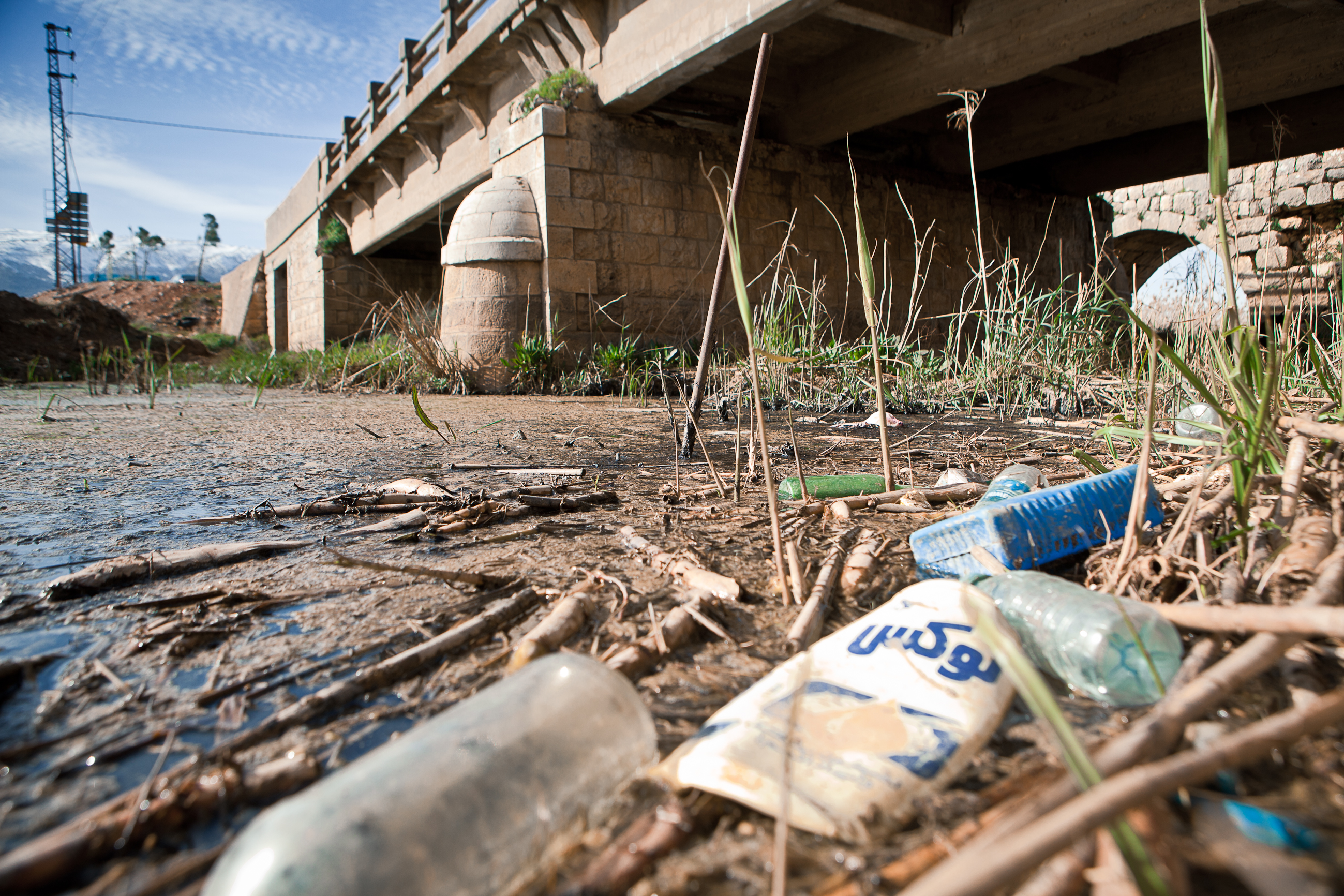
The rectangular glass walls of Fathi Chatila’s office in Hamra make visitors feel much like they are in an aquarium without water; perhaps that is appropriate for a hydro-geologist concerned with Lebanon’s water woes. Chatila, also the editor-in-chief of Arab Water World magazine, has been leading a campaign aimed at changing the heavily-indebted Lebanese government’s expensive water ways since 1996. His efforts thus far have been somewhat in vain; since the 1970s, the focus in upgrading Lebanon’s decrepit water infrastructure has been on large-scale projects that require more long-term funding, not less.
For a fiscally stable country this is a viable option, but Lebanon is anything but; it currently maintains a public debt around one-and-a-half times its annual economic output. The country loses 1.8 percent of its gross domestic product — or around $433 million — per year from the cost of inaction on water infrastructure, according to the World Bank. That figure doesn’t include the estimated $87 million spent annually by the Lebanese on private water due to the lack of a clean and reliable supply at the tap. Despite these financial burdens, the most recent plan to improve Lebanon’s water distribution capabilities, which appears close to adoption, is by no means an exception to the rule of expensive tastes.
In December of last year the World Bank gave its first nod of approval to Lebanon’s water sector regarding what those at the bank call the Greater Beirut Water Supply Project (GBWSP), also known as the Awali Project.
Ultimately, the project plans to provide constant water supply to Baabda, Aley, parts of Metn and the Mount Lebanon region, as well as to an estimated 350,000 low-income residents of Southern Beirut’s suburbs. The total cost of the project would come to approximately $370 million, of which the World Bank would put up $200 million in loans, the Beirut and Mount Lebanon Water Establishment (BMLWE) some $140 million and the Lebanese government the rest.
In a country where the areas outside the capital city are often neglected by public services — such as proper roads and electricity — water infrastructure is the rural revenge on city folk. On average, residents of the city suffer the most during the summer season, when average water supply reaches just three hours per day, if that. The water deficit in 2008 was measured at between 40 to 50 million cubic meters (MCM) per year by the Council for Development and Reconstruction (CDR), a financially autonomous public institution, accountable only to the cabinet, which plans and implements development projects. Furthermore, the BMLWE estimates that by 2025 the deficit will rise to 100 MCM.
In the short term, the GBWSP seeks to provide 24-hour supply to the areas that have suffered most. The project plans to take 50 MCM of water from the Qaraoun reservoir in the Western Bekaa — one of only two surface water storage structures built in the country since the 1960s — fed by the Litani River. The water will then be rerouted to the Awali river, treated and then conveyed to Greater Beirut, where, according the Ministry of Energy and Water (MoEW), a new network is currently being built that will distribute it to consumers whose homes are to be fitted with new meters.
In total, 200,000 new meters will be installed as part of a pilot project to reshape Lebanon’s water tariff structure. Currently, households are charged a flat fee depending on location (from $156.5 in Beirut and Mount Lebanon to $117.4 in the Bekaa). This will give way to a volumetric tariff in these areas, initially at a rate of $0.39 per cubic meter of water, before increasing to a level that allows water establishments to break even in their operational and maintenance costs, according to the MoEW’s draft National Water Sector Strategy. It should be noted that none of this will be possible without a cabinet decision to change tariffs and, as of Executive going to press, no cabinet had been formed.
Hitch in the road
The GBWSP seemed to be going smoothly until last month when the World Bank announced that it would “expand a study already in process on water quality issues to cover water availability and costs,” after a report was submitted to the bank’s board of executive directors by the Inspection Panel, a “bottom-up” accountability and recourse mechanism of the World Bank that allows residents to file complaints to the board. It was hydro-geologist Chatila who authored the initial 21-page complaint signed by around 50 residents of Greater Beirut and submitted to the panel last November under the title, “Presenting a Much Better Project: Damour Dam.”
“If they accept the panel’s report or not, there is a crime that is going to happen against the residents of Beirut and the country,” says Chatila, in reference to the GBWSP. “It makes no sense that the water of the Damour River, [which] is just a short distance from Beirut and is clean and cheaper, is not brought to the city.”
Chatila has been lobbying the government to implement the proposed Damour river dam since 1996, he says, when he conducted his own study on the feasibility of placing a dam some two kilometers east of the juncture where the Damour meets the Al Hammam River, which he then submitted to the relevant water authorities.
The idea of using the water in the Damour River to supply Greater Beirut was first rejected in 1970 when the Lebanese cabinet decided instead on the plan that has since become the GBWSP, which would operate from April to October: the dry season. The decision came as a result of studies carried out by the Ministry of Energy and Water and the Litani River Authority, which stated that only 5 MCM (as opposed to Qaraoun’s 50 MCM) could be stored by a dam on the Damour River and called for the idea to be scrapped.
Again in 1998 the Ministry of Energy and Water reaffirmed this position in a letter sent to Chatila stating that after consulting with international experts, including those from Électricité de France and the United Nations Food and Agriculture Organization (FAO). It stated that “the geological formations are highly fissured and the solutions are very expensive and complicated, and even impossible, hence we decided to neglect it.”
After following up on the matter with FAO hydro-geologist Alain Guerre, Chatila claims he was told that the studies were only done at a location in the Beiteddine village of Al Samkaniyeh, not at the location much further downstream where he had performed his own research. Despite this, Chatila says he managed to lobby the cabinet, which eventually issued a decree on September 1, 1999, to compile the conditions for carrying out a feasibility study at the Damour river and to launch a tender a month later.
On September 8 the cabinet asked the CDR to commission Guerre and Chatila to work on the project. Chatila then claims that on September 25 Guerre received a phone call from Lebanon informing him that his life would be in danger if he came to Beirut. Guerre then sent an email to Chatila saying he would not be able to come to Lebanon for personal reasons. Guerre did not respond to a request to comment for this story.
Later that same September, CDR commissioned Peter Rae of Harza Engineering, now Montgomery Watson Harza (MWH), to carry out a preliminary report, which was submitted in November 1999 and stated that a dam on the Damour river could store 63 MCM at a cost of $90 million, or 90 MCM at a cost $140 million, but two years would be needed for complete feasibility to be covered. According to Chatila, the CDR called in another firm by the name of Water Engineering, which considered the geological formations in the Damour River and the hydro-geological conditions prevailing in the area “ideal” for the formation of a reservoir.

Another CDR-commissioned study was then performed by Harza Engineering, which found that a 60 MCM dam was technically feasible. In 2005, a war of words erupted in the press between Chatila and then president of the CDR Al Fadel Shalak, after which Chatila claimed he was physically forced out of the CDR offices.
In 2007 the CDR again asked Liban Consult to carry out feasibility studies on building a dam at the Damour River. Liban Consult announced in 2009 that it was possible to store 42 MCM for a cost of $90 million. “I will not question the results of the studies reached by Liban Consult for the Damour Dam, although I know that such results were pre-determined by CDR even before the feasibility studies took place,” reads the complaint letter authored by Chatila. “I will nevertheless accept all that has been mentioned by Liban Consult… although this study does not reflect the real storage conditions at the Damour river… The dam site I have located… will store over 90 MCM at a very low rate.” The CDR, the World Bank and Montgomery Watson Harza did not respond to repeated requests for comment.
“Damour is a viable option to look at and I don’t think it has been given a chance,” says Nadim Farajallah, professor of hydrology and water resources at the American University of Beirut (AUB).
What now?
Despite the fact that a cabinet decision to conduct a full feasibility study has been overlooked for years, the Damour dam project has not been written off entirely, as it was in the 1970s. The dam was included in the government’s 10-year water storage project, which expired last year, and the MoEW’s current draft National Water Sector Strategy, at a cost of $150 million to store 39 MCM. As for the GBWSP, the MoEW, which is tasked with executing the project, does not seem fazed by the latest concerns raised by the World Bank’s top decision-makers.
“There are no implications on the project; as far as we are concerned we are moving and there is a board decision to grant this money,” says Randa Nimer, advisor to the Minister of Energy and Water. “If they decide to stop the funding, then fine, we will find another donor. At the end of the day let’s agree on one thing, this is not charity; we are paying interest.”
According to Nimer, the reason the ministry is pressing ahead is that, despite what potential other options such as Damour might hold, the GBWSP is the only project for Beirut that is ready to go; the potential alternatives don’t have a final design or funding lined up. “For Damour, the World Bank wanted a sophisticated environmental assessment, and it was not ready and would take at least a year.”
Initially, the ministry was looking at integrating the Damour project with the GBWSP but found that there would be no place to treat the Damour water before it converged with water from Lake Qaraoun, which would already be treated at Ouardaniyeh, explains Nimer. “With Damour you need to have your conveyor with raw water, treat it somewhere near Hazmieh and then distribute,” she says. As a result the projects will have to be done separately.
Nimer says she “refuses” to accept the premise that Damour should be compared to the GBWSP because, at the end of the day, Beirut will need the GBWSP, the Damour dam, as well as dams at Bisri and Janah, so whether the cost per cubic meter for one is greater than the other should not be a major concern [see table].
Moreover, she explains that the conveyor being built for the GBWSP will have a capacity of 150 MCM to take water from the planned Bisri dam, and adds that Damour is planning to be integrated with the Janah dam, which will bring somewhere from 30 to 40 MCM on its own. “If I need water for Beirut, from Awali, Damour and Bisri, you cannot tell me Damour is $2 [per cubic meter (CM)] and Awali is $3 [per CM], so don’t do Awali,” she says hypothetically. All of them are projects that the MoEW is “going to implement in the next five to 10 years so [let’s] not compare prices between these. This is what is available and what I can do to bring water to Beirut.”
Not just cost
But the objections of Chatila and the Greater Beirut residents do not stop at merely cost and timing. Many of the opponents of the GBWSP cite the historically bad water quality of Qaraoun reservoir and the upper Litani River as the main reason they do not want the water. Residents around the Qaraoun in the West Bekaa have refused to use its water, opting instead to spend some $50 million under the auspices of the Council for the South, another public, financially autonomous body, to bring water from the low-lying Zarqa spring to their areas.
Arif Dia, professor of hydrobiology at the Lebanese University and a specialist in water contamination, has conducted studies on the Qaraoun, Litani, Awali and Damour rivers. He confirms that the waters of the Qaraoun are problematic. “I did a biological study and really life cannot exist in the Qaraoun. It’s scary how dirty it is,” he says. “The Damour’s water is safer for sure. Between all of the rivers it’s the best.”
Chatila claims that the water from the Qaraoun contains trace elements and heavy metal remnants of carcinogenic minerals such as zinc and lead bromide, which cannot be treated. However, both Dia and AUB’s Farajallah deny this. “You can remove anything from water; they drink from the Thames, don’t they?” said Farajallah. “But the more you treat the more you pay. If you have the money you have the solution.”
Dia adds: “You need advanced technology, and I doubt that this exists in Lebanon… You know, these issues need a lot of care and are delicate and I am doubtful we have the capability.”
According to Nimer, beginning in April of last year the ministry began conducting weekly tests on the water at several locations of the project, including the Qaraoun reservoir for 11 months, and cross-checked these results with those from the Litani River Authority once a month. “The result is that the water is good and does not contain carcinogenic materials,” she said. “When the panel came and started raising the issue of water quality because [of] Chatila… the World Bank requested that we conduct further analysis… We had a team who went there, collected samples and sent them to the environment laboratory of AUB,” she added, saying that the samples would be ready by the end of March and others would be taken a month later to cross check. “That will be it because with the heavy metals you don’t do tests regularly, because either you have them or you don’t. I am not paying any more money on that issue.”
Whether or not the water is suitable for consumption or cost-effective treatment is one thing, but what’s certain is that the organs of the Lebanese government have not been able to identify the most cost-effective methods of managing the country’s water, in this case or in any other.
As a result the people have suffered, while millions of dollars have been paid to consultants for projects that were never started. Whether the GBWSP will suffer the same fate is a question of both time and money, but it alone will by no means solve the country’s chronic water problems.
For that to happen, Lebanon will need a cabinet to make a decision to pass a national water sector strategy, and it will have to stay in office long enough to implement it with its associated laws. Given the track record of ineffective cabinets and parliaments, the ambitions of the Lebanese water sector could very well end up washed out to sea, just like the valuable water in its rivers.
First published in Executive Magazine’s April 2011 issue
 The Lebanese are in the unfortunate position of empathizing with Vladimir and Estragon, the aimless dramatis personae from Samuel Beckett’s legendary “Waiting for Godot,” over their own absurdist Internet tragicomedy. Recently, signs have emerged that the country could be on the cusp of reaching a solution to its telecommunications purgatory. But, with the usual governmental skulduggery abounding, should Lebanon’s Godot actually arrive he may more resemble the Grim Reaper for the country’s private internet providers.
3G in the news
On January 28, Caretaker Minister of Telecommunications Charbel Nahas announced that his ministry was undertaking a project to bring third generation (3G) mobile services to the country over a period of seven months. Third generation technology is a means of incorporating high speed Internet with mobile devices such as “smart phones,” but subscribers will also be able to attach a simple device called a “dongle” to their computers and use the service the same way they currently use other wireless Internet products on the market such as the pervasive Mobi and Wise Box.
If the project goes as planned, users will be able to transfer data over mobile devices at speeds of up to 21 megabits per second (mbps). When compared to the current average speed of 0.1 mbps using the general packet radio service (GPRS), the upgrade undoubtedly constitutes nothing less than a game changer in the Lebanese Internet arena.
The projects will leapfrog the fixed digital subscriber line (DSL) Internet market, which is still waiting for a fiber-optic backbone to be built.
As part of the plan, the state-owned telecom companies Mobile Interim Company One (MIC1), managed by Orascom Telecom’s Alfa, and Mobile Interim Company Two (MIC2), managed by Zain telecom’s MTC Touch, will build an almost completely new network. Contracts to do so have already been signed with the Swedish company Ericsson to build MIC1’s network for $36.2 million, and with the Chinese Huawei to build MIC2’s network for $25.6 million. Nokia-Siemens will build a $2.7 billion control center.
Almost immediately after the announcement the elation was palpable, with many in the media and business community heralding the upgrade as the beginning of the end of the country’s Internet woes. However, those in the industry’s private sector were less enthralled, fearing that the projects could lead to a complete “nationalization” of the country’s already widely state-owned telecommunications sector — an understandable concern given the private sector’s often contentious past with the government.
DSL’s overhang
In 2006, when DSL Internet was being introduced to the market, the telecommunications ministry, then under Marwan Hamade, signed a memorandum of understanding (MoU) with private sector players, known as Data Service Providers (DSP) and Internet Service Providers (ISP), stating that the government intended to compete with them on a level playing field. Data and Internet provision is currently the only area in which the private sector is allowed to participate in the telecommunications sector.
Lebanon’s Internet infrastructure
The need for an MoU stemmed from the fact that Lebanon’s telecommunications legislation (Law 431 was passed in 2002) had at that time not yet come into effect due to the fact that the institutions it mandated — the Telecom Regulatory Authority (TRA) and Liban Telecom, a government-owned body with a corporate framework that eventually is supposed to replace the telecommunications ministry — had not yet been appointed by the Council of Ministers, Lebanon’s cabinet.
The MoU was also required because the government, through Ogero, Lebanon’s state-owned fixed-line telecommunications monopoly operator, had an inherent competitive advantage over the private sector. At the time, Ogero owned the infrastructure needed for DSL, particularly at the “central offices” (COs), distribution centers in each neighborhood that are needed to dole out DSL to customers. Even with a legal framework in place to promote the private sector’s participation in the industry, the government broke the agreement and shored up its control.
“Ogero initially started its DSL in 35 ‘central offices’ and let the private sector [use] 34, with the one in Solidere off limits,” says Imad Tarabay, secretary general of the Lebanese Telecom Association (LTA), which represents Lebanon’s private-sector data and Internet providers. “Since then, Ogero expanded from 35 to 171 [COs, which] the DSPs were not allowed [to use].”
Tarabay, who doubles as chairman of Cedarcom, which owns the Mobi wireless service, explains that because Ogero knew in advance when a neighborhood was ready for DSL they would call the subscribers in the area — naturally, they already had their numbers — and offer them DSL before the private sector could have a chance to offer them the service. “They shaved everyone,” he quips, slicing his hand across his desk.
According to the LTA, the result of what they call “unfair practices” caused the DSL environment to become even more lopsided in favor of the government, which they now estimate controls almost 80 percent of the market. Last month, Cedarcom and another DSP, Broadband Plus, filed lawsuits against the telecommunications ministry, stating that the companies had bought and deployed equipment around the country in preparation for DSL’s launch in 2007 but were prevented from operating them by Ogero.
“The Ministry of Telecommunications [MoT] gave permits to Cedarcom to install DSL equipment in 34 exchanges (COs), issued a decision [that it would] link the 34 exchanges to [Cedarcom’s] headquarters and then refrained from linking them for no reason whatsoever,” says Tarabay [see graph]. “This led Cedarcom to have zero DSL clients, while Ogero has an estimated 200,000 and other Data Service Providers (DSPs) have 40,000.”
When asked whether these practices were fair, Mahassen Ajam, commissioner and board member of the TRA, Lebanon’s telecommunications regulator that is legally mandated to promote competition in the market, sympathizes with Tarabay. “No, it’s not fair… the major rules of fair competition were never applied by the ministry.” The telecom ministry did not respond to Executive’s request for comment.
Fiscal fumble
According to official figures, last year the government made more than $2 billion in revenues from the sector with 58 percent of it in the form of taxes on the consumer.
What most people don’t realize is that 20 percent of the revenues that DSPs garner from their operations go to the government under the conditions of their “interim transitory licenses” that are only valid for one year, thus discouraging the DSPs from making long term investments. The DSPs also pay around $66,300 per year for the frequencies they use to transmit their Internet signal. They also pay net income taxes, dividend distribution tax, site rentals, $2,700 per 2.048 mbps of bandwidth (the government pays less than $100) and a $41 dollar installation fee for a DSL line at a customer site. The government pays practically none of these fees [see table].
In October 2010, Lebanon’s four private DSPs paid $438,638 to the TRA in license fees. That figure is greater than the 25-year license fees for all four operators in Finland, where broadband Internet has been considered a human right. According to LTA, the amount of taxes they pay amounts to 59 percent of their operational revenue, a tax figure similar to that paid by citizens for telecommunications services. At least in this respect it seems the government is treating everyone equally.

The 3G hatchet
Given this fiscal disadvantage, it’s a wonder to many how the private sector keeps its head above water. It has done so ostensibly because it is able to offer value added services to customers on a competitive basis. But now that 3G services are about to hit the market, they are predictably crying foul.
Their fear is that if MIC1 and MIC2 enter the market with such a large fiscal and technical imbalance between them and the licensed service providers, there will be absolutely no way for the existing operators to survive.
Currently, licensed providers offer wireless Internet for prices of around $40 per month to cover their costs and taxation. If you remove taxation, as has happened with MIC1/MIC2, that figure becomes something like $20 per month. What’s more, licensed service providers can presently offer a maximum speed of around 0.5 mbps, which is nothing close to what 3G could bring. Furthermore, MIC1 and MIC2 have an existing subscriber base of more than 2.5 million customers to draw on while the licensed providers have around 80,000. Despite the market’s lopsidedness, introducing 3G without leveling the playing field is exactly what the telecom ministry is planning to do.
“We are in a dominant position, which is very normal given the size we have in the country,” says Marwan Hayek, chief executive officer of Alfa, which manages MIC1 on behalf of the government. “If we had a 100 percent private license, and we were not dependent on the MoT, the same scenario would happen,” he adds, stressing that the private sector maintains the advantage of being able to manipulate prices, while he has no such luxury.
“Failure to ensure fair competition between Alfa and MTC (MIC1 and MIC2) and licensed operators, given all the advantages that Alfa and MTC have, will lead to the eminent annihilation of licensed ISPs/DSPs, meaning the extinction of the private sector operators in the Telecommunication Sector in Lebanon, and in parallel, the creation of three state owned operators, which is contrary to the principles of Law 431,” says Tarabay.
If that comes to pass, the fate of more than 950 highly skilled employees working with the licensed providers will be put into question, according to the LTA. “What is the government asking us to do? To shut down and open businesses in another country,” asks Tarabay rhetorically.
Alfa’s Hayek believes that the situation is not so dire. “Even within the 3G deployment, [private sector companies] will have a role to play because, if you listen to the minister, he wants them to [be] a distribution VNO [Virtual Network Operator] type of business,” he says. A VNO can take many different forms but is basically an arrangement between the owners of a telecom asset and a company whereby it performs services, ranging from complete resale with separate branding to merely offering a back office service such as billing. An MVNO (Mobile Virtual Network Operator) refers to such an arrangement in the mobile telecom market.
“In terms of the ‘dream’ of offering an MVNO, whether they offer it or not it doesn’t mean we will let go of our rights, nor does it mean that the MVNO fixes the [fiscal] imbalance between Alfa/MTC and the Data Operators,” responds Tarabay.
“There are over seven levels of MVNO and we have been dialoguing with the TRA and MoT for over a year, whether as a company or the Lebanese Telecom Association. We have never received any feedback. Negotiating and discussing an MVNO is a process that can take months and there has not even been a draft to [outline] the guidelines,” he adds.
In theory, the licensed providers could opt to build their own networks with their interim licenses and compete with MIC1 and MIC2. This would cost them tens of millions of dollars, however, and be very risky from an operational continuity point of view given their temporary licenses. In the end, they would still have to get the telecom ministry’s approval to install networks that would compete with the state’s new 3G offering, which it plans to spend $80.3 million to build.
Bearing in mind the government’s recent history of boxing out the private sector from the market, that scenario seems highly unlikely. “I hear their concerns; I wish I could do something to help [the private sector] on the regulatory front or the licensing scheme because definitely they have the right to get a long- term license,” says Hayek. “We cannot help them. I wish I could but it’s not in our hands.”
To regulate or not to regulate?
To steer clear of any such conflict, the logical thing to do would be to place all market players on equal footing and allow them to compete against each other to drive the market forward and push prices down. The framework for such a state of affairs already exists in Law 431, whereby it assumes that all service operators will be licensed and regulated by the TRA in order to ensure fair competition.
The law, however, is rife with loopholes; when certain operators are not licensed their operations can only be regulated by the government through the MoT, and not by the TRA. Not surprisingly, the unlicensed parties in this case are the state-owned MIC1 and MIC2.
Both MIC1 and MIC2 were created in the early-2000s by the government, when Lebanon’s mobile telecommunications were tipped for privatization, with the intention of being sold within a period not exceeding six months. Since then they have existed as unlicensed privately registered companies owned by the government.
“Before MIC1/MIC2 have the ability to do the 3G projects they need some type of license, because even though they are owned by the government they are privately held companies, they are SALs, they are registered and they are, at the end of the day, operators because they are invoicing,” says a legal expert in public law who supports the private sector’s position, speaking on condition of anonymity.
According to Minister Nahas, it is not necessary for MIC1 and MIC2 to be subject to the same licensing conditions as private operators.
“It is said that the matter requires a license, in spite of the fact that the state does not need a license and does not give licenses to itself. It is legitimate in and of itself,” he said at a June 28, 2010 press conference. “The funds are part of the revenues of private companies making investments to develop operations, just as Middle East Airlines [majority owned by the Central Bank] makes investments, keeping in mind that it is state-owned.”
However, the Lebanese Civil Aviation Authority, Lebanon’s civil aviation regulator, licenses Middle East Airlines to operate in the Lebanese market, albeit also in a monopolistic manner.
Law 431 lays out the conditions for any new project to be conducted under Article 19, which dictates that a license is to be issued by the cabinet according to terms of reference prepared by the TRA for “new categories of licenses for providing public telecommunications services.”
The law also states that the TRA is to issue licenses for “Internet services,” and “data services,” both of which apply to the 3G projects. The issue of licenses is particularly divisive for several reasons; licensed operators are subject to TRA regulations, meaning that the MoT would exercise less control over these entities. This also means that these entities must conform to TRA regulations that pass from the TRA to the telecom ministry and are then forwarded to the Majlis Shura, or the State Council, Lebanon’s highest judicial authority. There they are ratified and enacted into law upon publication in the Official Gazette.
Another reason that licensing is crucial in Lebanon is because the TRA specifies the spectrum a provider can use to offer a service. Spectrum is a specific range of frequencies, measured in hertz, that all telecommunications services — including radio, TV and Internet — need to use to transmit signals.
Hence, if MIC1 or MIC2 are granted spectrum, which they have been, by law they should be licensed and the process should be conducted by the TRA. Indeed, the last time these two companies required spectrum to expand their mobile networks and add capacity for more subscribers in 2008, the TRA allocated it to them. At the time, the cabinet approved the expansion and it was published in the Official Gazette, which confirmed that the TRA was the sole entity empowered to grant spectrum. Then, in December 2009, under the current minister’s tenure, they were again granted spectrum by the TRA.
In these cases, however, the TRA decided to grant the frequencies without licenses. “We granted frequencies because, at the end of the day, the TRA would like to see the mobile networks developing,” says Ajam. “We didn’t go into the legal aspect of being licensed or not. Now we have the same situation with 3G,” she says, adding that if they receive a request from either the minister, MIC1 or MIC2, they will follow the same course. “We will not take a stand against the interests of the country. You have to split things between the country’s needs and the needs of market dynamics.”
Who is significant?
Another way the TRA could impose fair market competition in the upcoming 3G market is by applying the already legal “Significant Market Power” (SMP) regulation, which is designed to enforce a competitive playing field between large corporations in a particular industry.
MIC1 and MIC2 would certainly qualify as such in the 3G Internet market. The regulation protects against cross-subsidizing services, such as using a voice market to leverage data customers, a likely practice if 3G is given solely to MIC1 or MIC2. Again, however, the issue comes full circle. “You can use it when someone is licensed, [but] the MoT is not and neither is MIC1 or MIC2. So the legal approach is very tough,” says the TRA’s Ajam. To issue its own licenses the TRA needs a “licensing regulation,” which it has forwarded to the ministry to send to the State Council. A resolution has yet to occur and the regulation is now collecting dust. “To go [directly] to the State Council there needs to be a conflict and the ministry is not issuing its own licenses, hence there is not conflict,” says Ajam. “If they do give their own licenses then we will go to the State Council and wait for its decision.”
The minister’s missing policy
The minister can legally maintain that he has the right to uphold the regulations he chooses because he is also empowered by the law to set the “general rules for the regulation of telecommunications services in Lebanon,” according to Law 431.
The minister prior to Nahas, Gebran Bassil, who is from the same party, actually published a policy paper setting “General Rules for Regulating the Telecom Market,” whereby he advocated issuing long-term licenses to existing service providers, as well as to MIC1 and MIC2, in addition to introducing 3G. As such, the current situation is difficult to frame as being purely politically motivated.
Despite previously stating that he would issue his own policy, Minister Nahas has since reneged and removed the policy paper from the ministry’s website. Last December his advisor told Executive that the only policies the minister would call for would be lower pricing and an end to the state monopoly over telecommunications.
“The policy of the ministry is not a matter of paper, it is a matter of practice,” said Nahas in November at a press conference.
In any case, the TRA can hardly afford to anger the minister. Their budget comes from the treasury and has to have the minister’s approval before they can receive it. This year the staff at the TRA went four months without receiving pay because the ministry did not approve their budget.
Taking care of business
It is worth noting that the contracts signed by the telecommunications ministry were done so when the cabinet was in “caretaker mode,” after he and others resigned from the cabinet on January 12. The legal debate over ministers’ powers while they are “caretakers” is an open one.
“Administrative law is in essence not a written law. The principles of administrative law are prescribed by the practice and by the decisions of the State Council,” says the legal expert. “Caretaker status is a restrictively interpreted concept which talks about making sure that the usual basic everyday business carries on. When the minister is either empowered by the Council of Ministers or parliament to do something prior to entry into the caretaker period it would be normal for the minister to go on with the process of doing so.”
The lawyer agreed that the minister had the right to start the tendering process but deemed that the issuance of purchase orders and signing of contracts were beyond the purview of caretaker ministers.
Alfa’s Hayek confirmed that the negotiations with vendors occurred subsequent to the government’s collapse but shifted the burden of proof as to whether this action is legal away from his company. “We don’t really question the legality of such actions or steps taken by the government because it’s their worry, not ours,” he said. Still, Minister Nahas believes the contracts are “100 percent legal.”
“Construction and equipment are among the ministry’s normal tasks, in addition to the fact that this operation began before the government’s resignation,” he said on January 28. “It is incumbent on the telecommunications minister to not stop natural work that is part of two private companies’ operations, especially if they are state-owned. It is not permissible for public ownership to be an obstacle to the people’s service.”
Land of no law
Executive has learned that several members of the private sector are preparing to file lawsuits against the MoT in response to the announcement of the 3G projects. This move follows letters sent to both Caretaker Prime Minister Saad Hariri and Prime Minister Designate Najib Mikati, asking them to remedy the situation.
As far as the ministry is concerned, however, there is little to worry over, as Minister Nahas has stated, Law 431 serves as little more than a recommendation.
“Law 431 makes its application dependent on the fulfillment of its conditions,” said Nahas last year. “This law is still inapplicable because its conditions are not completely fulfilled. This matter is clearly stipulated in one of the law’s clauses.” Indeed there are several clauses that refer to the applicability of the law, starting with Article 51, which states that previous legal and regulatory provisions remain effective until law goes into effect. Article 52 states that “technicalities regarding the implementation of the present Act [Law 431] shall, if needed, be determined by the Council of Ministers upon the proposal of the competent Minister.”
By default the minister has the power to assess what is needed. According to the legal expert, since the TRA was appointed by the Council of Ministers upon the request of a minister preceding Nahas, its functions and prerogatives are applicable. That would mean that the TRA can legally issue regulations, such as the licensing regulation that the minister is keeping from reaching the State Council. Ironically, he is empowered to do so by the very law that he deems inapplicable.
“We respect the point of view of the minister, however the TRA has been appointed in March 2007 as a direct application of Law 431, so this means that Law 431 is in effect,” says the TRA’s Ajam. “We will defend the TRA, the TRA’s role and the law and we will continue to assume our responsibilities as defined in Law 431.”
Uncertain future
Whether the issue ever gets to the State Council is uncertain. Until then the 3G project is moving forward, as are the cases against the ministry and efforts to assemble a new cabinet that may see the present minister stay or go. Whatever the result, the contentious disputes over the basic structure of the telecommunications market is putting into serious doubt on the future of the country’s Internet reform.
“One hand cannot clap by itself,” says Ajam, recounting an old Arabic proverb. “We need all the concerned parties, especially the decision makers, to be involved in this, otherwise no one will succeed — not us, not the private sector and not the country.”
First published in Executive Magazine’s March 2011 issue

In most countries the national budget is a serious matter for debate and proof of a government’s commitment to its citizens. Byzantine quarrels over the issue echo yearly in the halls of parliaments across the globe, with opposition and ruling parties at each other’s throats as they attempt to hammer out a compromise to suit the political and fiscal reality of the day. In the Gulf Cooperation Council things are much more straightforward; the amounts the rulers decide are translated into what is spent on the ground.
More often than not that means there is little debate over where to allocate spending or if the figures and calculations are compiled in a realistic manner. The trend of GCC sovereign budgets in the wake of the economic downturn has been, and continues to be, to run countercyclical budgets in an attempt to stave off the adverse effects of the recession and to keep the national population happy enough to maintain the status quo.
“It comes back down to a policy driven recovery with significant public spending in the hope that it revives the private sector,” says Oliver Cornock, regional editor for the Gulf Cooperation Council at Oxford Business Group.
Judging from the budgets that have been released for 2011, this policy looks likely to continue, albeit at a marginally lower level than was seen during the fiscal crisis management years of 2009 and 2010. In total, federal budgets active in 2011 (Kuwait and Qatar run fiscal years to March 31) have a target of $297.7 billion in spending.
Questionable settings
That amount originates, for the most part, from the region’s vast hydrocarbon resources. But just how much those resources are worth to each government can make the difference between the budgets being credible reflections of the economy or a ceremonial scrap of paper.
“You [should] take these budgets with a pinch of salt because the oil price assumptions are way off base,” says Ayesha Sabavala, deputy editor and economist for the Middle East and North Africa at the Economist Intelligence Unit (EIU). “Most of these fiscal budgets are extremely expansionary. If they don’t increase the oil price they base the budget on, they are going to have severe deficits showing in all their budget accounts.”
Budget deficits / surpluses across the GCC
Both Saudi Arabia and the United Arab Emirates, the region’s two largest economies, have not specified their oil prices and, according to the EIU, the Emirates’ federal budget does not take into account oil revenues. Kuwait has proposed an oil price for its upcoming fiscal year at $60 per barrel, while Oman and Qatar have also budgeted at $58 and $55 dollars respectively. Most international financial institutions’ estimates for the year are around $90 a barrel and prices have been trending upwards, with Brent crude hitting a two year high of $108 per barrel last month on the back of the uprising in Libya.
There is some logic to the seemingly low expectations of the GCC’s finance ministries. Not long ago oil prices dove from more than $100 a barrel to around $45 a barrel. In the case of budgeting, erring on the side of caution may just be the best way to go. “It’s very easy to think of prices going up and up and up from a Western perspective, but when you go the other way it would be a huge shock if you were banking on $55 a barrel and you got $42,” says Cornock. “It has suited the GCC pretty well to do it this way and will do so for the foreseeable future.”
To be fair, sovereign oil price estimations in 2010 and 2011 have edged upwards in comparison to previous years. Ostensibly, the reason for this is that governments have sought to show greater revenues on their books to mask the effect of rising expenditures needed to keep their economies buoyant and support their wide-ranging subsidy schemes.
A brawl in Bahrain
One nation to recently break the oil price mold is Bahrain, which set a price of $80 per barrel in their bi-annual 2011/2012 budget, before the uprising began in February. Bahrain has also steadily spent a much larger portion of its revenues on defense (around 20 percent of its current budget allocation) than other countries in the GCC.
“The budget introduced in January is obviously not going to stand in light of these protests,” says Sabavala. “If anything we are going to see expenditure rise even more with all the allocations that have been made to families, subsidies and infrastructure spending that is trying to keep the local population quiet,” she says, adding that she expects the regime to survive. “At most they will be able to get rid of the uncle,” she posits, referring to the king’s highly unpopular Prime Minister Prince Khalifa, who has been accused of corruption and is widely blamed for the economic and political marginalization of Bahrain’s Shia majority population.
Smart investment
Another theme of budgets in the GCC is the increasing amount of capital being spent on education. Saudi Arabia alone is planning to spend $40 billion on education while Oman is expected to increase its allocation by $137.8 million to hit $2.4 billion, which is larger than the deficit they are projecting for the whole country.
According to Cornock, these large allocations are part of a general ‘longer-term’ strategy that the different countries are now starting to reflect in their budgets. “They are now able to play the long game: to invest in education and in incubator projects, as well as the public sector, with the hope that it will trickle down into the private sector,” he says. “It’s all there but its all conjecture and none of this will happen overnight.”
Ultimately, whatever allocations are made, many of the budget books are expected to tilt toward surpluses, even if the governments declare otherwise. For example, Kuwait has currently budgeted a deficit of $16 billion on its $64 billion budget but posted a surplus of $21.38 billion during the first eight months of the fiscal year because of high oil prices and under-spending on its budget targets. “All they need is over two months of oil at over $90 a barrel and they are sorted [out],” quips Cornock. “I really don’t think its such a huge argument, and they have significant foreign assets and the KIA [Kuwait Investment Authority, Kuwait’s sovereign wealth fund] is always there to back them up.”
Qatar plays the optimist
On the opposite side of the spending coin is Qatar, which has been enjoying bumper growth while others such as the UAE and Kuwait have been picking up the pieces following the downturn. The country has consistently overspent on its budgets. Now that it has to build world-class infrastructure for the 2022 World Cup it will need to spend even more.
As the country with the lowest oil price setting, a projected $2.2 billion surplus seems almost laughable. There have been some fears, however, that the excess public spending will crowd out private sector initiatives that are essential for growth.
“There comes a point when public spending becomes such a huge part of the economy that inevitably the private sector plays catch-up,” warns Cornock. “The flipside is the contracting and the financing. I mean just think about the opportunities for banks. There will be plenty of opportunity if it is managed correctly and it’s 11 years till that World Cup; that’s a lot of time.”
The same seems to apply for the region’s largest economy. “We have seen that what the Saudi government has projected and what has actually come out in terms of the surpluses has been vastly different, which just goes to prove that a lot of these budgets are not really reflective of what actually happens in the economy,” adds Sabavala.
Whatever the outcome, the economic objective of any government will need to be fulfilled: jobs need to be created. Now more than ever, governments in the region have to be responsive to the needs of their local populations to avoid the kind of social unrest that has toppled governments across North Africa and threatened them across the Arab world.
Subsidies for items such as basic foodstuffs and petrol, in addition to handouts to nationals, run counter to encouraging citizens to seek out private sector employment. For now at least, it seems these practices will remain in place.
Last month, upon the Saudi king’s return from New York where he was undergoing medical treatment, he dished out a whopping $36 billion in new subsidies that included housing loans, unemployment benefits and debt forgiveness.
“It’s a bit of balancing act, and there are contradictory policies that need to be changed in the long term, but it’s not something that is going to be able to be implemented immediately,” says Sabavala. “It will always be about keeping the small local population happy but we see now that this cannot be taken for granted. Local populations are looking for more and more, such as higher wages and more say in the political process.”
First published in Executive Magazine’s March 2011 issue

As the wheels slowly fell off yet another ‘national unity’ government last month, Lebanon’s political class apparently had enough time to re-hash some old ideas and present them as legislation. But of all the bad ideas that Lebanese politicians have come up with to preserve the “diversity” of the country, the most recent draft law proposed by Labor Minister Butros Harb is likely the most regressive and divisive.
Harb’s proposal to ban the sale of land between individuals from different religions for a period of 15 years is nothing new and stems back as far as the 1860s, when Lebanon’s first “civil war” erupted. But supposing that the minister has read the constitution, he would know all too well that his proposal contravenes the principles of equality among the Lebanese, the right to private property, a free economy, and the fact that “there is no segregation of the people on the basis of any type of belonging, and no fragmentation, partition, or colonization.”
Then again, government regularly makes a habit of ignoring the constitution, from its obligation to hold timely sessions of parliament to that of passing a national budget, so perhaps we should regard Harb’s proposal as par for the course. At a time when the issue of Christians in the Middle East is particularly loaded, Harb may have used the opportunity to promote himself as the torchbearer of age-old Christian paranoia over being engulfed by the wider Muslim, and in this case Shia, population.
One reason for the draft law stems from allegations that parties such as Hezbollah are behind real estate purchases in “Christian” areas. If that is the problem, however, Harb could have used his legislative ingenuity to propose measures to lift banking secrecy on the accounts of public officials and their relatives and increase the transparency of financial transactions by political parties. That, however, might not go over well with his colleagues in government, who use banking secrecy to circumvent campaign finance laws to help buy their way into office.
A more relevant move for Harb in his capacity as labor minister would be to propose a measure to stamp out sectarian discrimination in the workplace.
Unfortunately, it makes more political sense to stoke sectarian fears and claim to be defending your own than to stick your neck out and actually propose something that takes aim at the institution of Lebanese sectarianism. For starters, if the intention of any law is to protect a particular sect then it is by definition discriminatory and will only serve to increase divisions rather than do away with them. The idea that people from sects that did not traditionally reside in places like Keserwan or Batroun now want to buy property there should not be thought of as particularly grotesque, unless one truly believes that each sect should have its own ghetto and Lebanon is nothing more than a collection of Bantustans.
If Harb truly fears for his community, then he should have used his position as both a member of Parliament and a minister to dismantle the institution of sectarianism by insisting that the cabinet form the constitutionally mandated committee to abolish the practice in society, and that legal structures of a secular state are voted on by parliament. True to form, neither Harb nor any of his colleagues has yet been brave enough to seriously propose either, preferring instead to use such suggestions as a political bargaining tool, happy that they can collect their paychecks and kickbacks based, effectively, on their own sect.
The mantra of coexistence between sects cannot just be a pretty phrase that we blindly recite to foreigners before rejecting citizens from “our” areas because they pray on Friday or Sunday. The fact that the country is already staunchly segregated is not something to be proud of, nor a condition to be supported through legislation.
For all their faults, the Constitution and the Taif Accord lay out the framework that intends to eventually abolish the stain of sectarianism. The Lebanese, including Harb, should not forget that the people and their government are not bound by any other social contract. So the next time a minister or MP would like to propose legislation to protect their community from the “dominance” of other sects, they would do well to start with that in mind and leave the sectarian laws where they belong: as things of the past.
First published in Executive Magazine’s February 2011 issue.

Oil has been interchangeably called “black gold” and the “devil’s excrement,” having both enriched the coffers of nations and pit them at war; it creates the capital for investment yet often destroys the development of other sectors in an economy. It is perhaps fitting then, that Lebanese politicians have recently found renewed impetus to squabble with each other over how to pry open the lid of this cursed treasure under the sea floor off our shores.
Lebanon’s slick history
The idea is not novel to those who have been following it. Oil and gas prospectors have long suspected the presence of hydrocarbons in the country, and there was a time when Lebanon had a proficient energy production industry.
Before the outbreak of the 1975-1990 civil war, Lebanon used to refine oil in both Tripoli and Zahrani, supplied either by ship or overland via the old Trans-Arabian pipeline, which still runs from Qaisumah in Saudi Arabia to Zahrani. Supplies were then refined and even exported.
“We could regain our position as a major strategic transit country, like we used to be
before the 1970s, but we are not going to be Qatar or Saudi,” says Roudi Baroudi, independent energy consultant and Secretary General of the World Energy Council’s (WEC) Lebanon Member Committee.
Today, however, Lebanon’s oil and gas infrastructure lies in tatters, with the country unable to cover its own energy needs, much less regain its position as a strategic oil and gas nation. What’s more, in comparison to its neighbors, Lebanon is far behind in terms of its progress in oil and gas exploration and production.
“Our real problem is that we are very slow and we are late; everybody is ahead of us,” says Mohamad Kabbani, head of the Parliamentary Committee for Public Works, Transport, Energy and Water and a member of parliament (MP) allied with the former Prime Minister Saad Hariri.
Lebanon has already drilled seven onshore exploration wells and is currently considering options to perform surveys again. It was former Prime Minister Rafiq Hariri’s government that shifted the focus to exploring the offshore area in the early 2000s. Since then, a number of seismic surveys have taken place off the coast of the country, and the results have piqued the interests of international oil companies (IOCs). The latest was conducted by the Norwegian firm PGS, which has recently concluded a full two-dimensional survey of Lebanon’s Exclusive Economic Zone (EEZ) — an area 200 miles (370.4 nautical kilometers) from the borders of a nation in which it can legally extract natural resources as per the United Nations Convention on the Law of the Sea.
According to Cesar Abu Khalil, advisor to the caretaker Minister of Energy and Water (MoEW) Gebran Bassil, who is part of the opposition Free Patriotic Movement, Lebanon has two-dimensional seismic data covering 23,500 square kilometers and 3,500 kilometers of three-dimensional seismic data. It also has an operational ‘data room’ where survey results can be viewed and analyzed, which is an essential condition for launching a bidding round. The information costs seismic companies tens of millions of dollars to acquire, which they then hope to turn around and sell to oil companies, with revenue from the sale shared with the Lebanese government.
The Lebanese treasury has already benefited from its sale along with the companies that have performed the surveys. More than 10 IOCs and national oil companies (NOCs) have bought data from the ministry and they are asking for more, says Abu Khalil, who added that no single company had all the seismic data. Baroudi estimates that if the entire offshore area of the country were licensed out, each portion in which companies are licensed to operate would require an investment between $3 million and $6 million to perform 3-dimensional surveys.
However, it remains to be seen whether these data purchases indicate genuine interest or are just efforts to keep the libraries of various IOCs and NOCs up to date.
Lebanon’s offshore area is part of the Syrian Arc, a geological structure of the earth that runs from Tadmor in Syria to Egypt and contains similar geological structures throughout. Lebanon is also part of the Levantine Basin, another structure located mostly beneath the waters of Lebanon, Israel, Cyprus and Syria. The government-run United States Geological Survey estimates that the basin contains some 1.7 billion barrels of recoverable oil and 3.45 trillion cubic meters of recoverable gas. That becomes more significant when considered with the fact that the offshore Nile Delta region of Egypt has had an 85 percent exploration success rate, according to Baroudi.
But the more recent findings offshore of Haifa, straddling the Lebanese and Cypriot maritime border, are the ones that have raised the greatest interest of prospectors, and the greatest concern among Lebanese.
The law
For all the promise the Lebanese offshore area holds, IOCs and NOCs have been loath in the past to seriously consider any foray into the country due to the absence of high-level regulation or legislation to protect potential investments. That changed last August when Lebanon’s parliament voted unanimously to pass legislation allowing for offshore exploration and production. The law had been lying dormant in parliament since the early part of last decade, unable to reach the floor due to a lack of political consensus and various conflicts among Lebanon’s political factions. At the behest of the Speaker of Parliament Nabih Berri — without whom no draft laws can come to the floor — the law was pushed through in a matter of days.
The borders
The reason for such haste was not only the backlog of legislation, but concern regarding activities south of the border. In January 2009, a joint United States-Israeli exploration group led by the US firm Noble Energy struck gold when they found a large natural gas deposit, dubbed Tamar, estimated at some 142 billion cubic meters (BCM) some 90 kilometers off the coast of Haifa and just south of the Lebanese border. A few months later the group made another find in the Dalit field, estimated to be about 10 percent the size of the Tamar find. Such monumental discoveries could turn Israel into an energy exporter, a prospect that whipped the usually sluggish Lebanese parliament into action.
But passing a law will hardly be sufficient to bring the country up to speed with the rest of the region, let alone make it an attractive destination for IOCs and NOCs to invest in exploration. For starters, Lebanon has not set its maritime borders with any of its neighbors. Back in 2007, Lebanon and Cyprus did agree on the delineation of their maritime borders, a necessary measure given the overlap of their EEZs. But the agreement is now stuck at the prime minister’s office, which has not sent it on to the Parliament to be ratified for fear of angering Turkey — which does not recognize the Cypriot government — according to Future Movement MP Kabbani.
Turkey is now a key mediator in efforts to resolve Lebanon’s political crisis after its cabinet collapsed last month. However, Lebanon not formalizing its borders with Cyprus means that royalties from any resources found in common fields — which the MoEW’s Abu Khalil suspects exist given the seismic data from companies that have operated in both countries — that extend to Lebanese and Cypriot waters cannot be divided between the two states as would be common practice according to the UN Law of the Sea, which both Lebanon and Cyprus have ratified. The prime minister’s office did not respond to Executive’s request for comment.
Cyprus is currently in the exploration phase after the success of its first bidding round and is expecting to contract areas that could contain common fields with Lebanon in the second half of this year, according to press reports. Cyprus has already awarded Noble Energy the rights to explore a 1,250-square-mile contract area bordering Israeli-claimed waters and formalized its borders with Israel in December of last year.
Syria — which already launched an unsuccessful exploration bidding round to attract interested companies and looks to be preparing for a second round this year — and Lebanon have not formally delineated their border, but Kabbani claims that “we can solve it with Syrians; it’s not a problem.”
But that is unlikely to assuage the fears of the IOCs and NOCs that will need to invest up to $250 million per block in design and development, with between $500 million and $600 million of foreign direct investment to actually build the infrastructure needed, according to the WEC’s Baroudi. Just in the exploration phase, he estimates companies will need to invest as much as $100 million, and a further $500 million individually or through joint ventures. Nonetheless, Baroudi believes that when all is said and done, Lebanon could bring in $3 billion per year in net earnings.
A regulator of sorts
Of course the revenues will have to be shared between the Lebanese government and the oil companies. According to the exploration law, each contract block will have to be bid on by a consortium of at least three companies under a production sharing agreement. Following a proposal by the energy minister, based on the opinion of “The Administrative Board for the Petroleum Sector,” the cabinet will decree the terms of the agreements for each block.
The administrative board itself will have to be appointed by the cabinet following a proposal by the minister. It will act as both regulator and consultant to the minister while also being under his purview. Kabbani explains that this structure was a focal point of the negotiation process to pass the law, whereby his party sought to water down the minister’s authority over the sector.
Having the board appointed by the Council of Ministers also implies that it will be subject to the sectarian trade-off of members, as are all administrative boards in Lebanon. That effectively means that if the sector is to be regulated according to best practices, and decisions are to be taken in a streamlined fashion, the cabinet, minister and board will all have to agree. At the time of this writing, there is no functioning cabinet, the backlog of decisions and appointments to be made numbers more than 300 and Lebanon is in the midst of a full-blown political crisis.
“The Council of Ministers does not study anything except if one minister gets a call from one of his supporters telling him something is wrong because there is an interest of one party or another; he goes in to defend his interests or his side’s interests,” says Kabbani. “The Council of Ministers is a bazaar, I am saying that and my boss is the prime minister; it’s a bazaar. Pass something for me so I pass something for you.”
Another contentious measure that has been postponed is the establishment of the country’s first sovereign wealth fund, intended to house the revenues of any hydrocarbon proceeds. Which political body would regulate the fund has proved to be a divisive issue, due to the fact that opposing political interests control bodies such as the finance ministry and the central bank (allied with the March 14 coalition) and the energy ministry (allied with the March 8 coalition). As a result, the law states that the details of how this fund will be structured are to be specified in another piece of legislation. “From now until we get our first oil and proceeds there is enough time for us to pass the law and manage the fund under it,” claims Abu Khalil.
Fortunately, Lebanon’s fractious politicians may have some time on their hands to resolve these matters. Before any bidding round is launched, the energy ministry will need to issue the bylaws. This process is being overseen by the minister’s advisors, who estimate that it will take another year before they are put in place. The decrees are related to exploration and they are “basically the priority,” says Danny Samaha, also an advisor to the (caretaker) energy minister.
According to the energy ministry, there are 28 pending decrees and 17 of them must be passed before the first licensing round can be launched. One of the most important decrees will draw the actual areas that foreign oil companies will eventually bid on. But when these are drawn by the ministry they will have to take into account the fact that the outer-lying areas of Lebanon’s EEZ have not been agreed upon, most notably not with Israel, with whom Lebanon is still officially at war.
Broader border problems
The past several months have seen particularly heated saber rattling over the maritime areas just south of Lebanon’s border. Both Israel and Lebanon have sworn to defend their interests, by force if necessary, with Hezbollah chipping in as well. At present the only non-official demarcation line that exists is a string of unofficial buoys off Ras Naqoura, planted by the Israelis upon withdrawing from the majority of the area they occupied in Lebanon up 2000. Last December, Israel’s infrastructure minister told Agence France Presse that their border demarcation with Cyprus “lays out the limit of the maritime border north of Israel and fixes the [sea] border with Lebanon.”
On Israel’s concessions map, a line across the northernmost area contracted to Noble Energy represents what is likely their interpretation of the border. However, if demarcation were to follow historical precedents, such as the military demarcation line between North and South Korea which, similar to lines of latitude, curves in relation to the shape of the earth, Lebanon may be entitled to a portion of the existing Israeli finds.
According to Kabbani, the Lebanese cabinet formed a committee last year headed by the Director General of Maritime Transport Abdel-Hafiz al-Qaisi to draw up the borders which were then sent the UN with the request to intercede to resolve the issue. The United Nations Force in Lebanon (UNIFIL), however, does not have the mandate to monitor or delineate the maritime border. “UNIFIL is concerned about a number of security incidents along the line of buoys since 2006,” reads a statement from UN Secretary General’s spokesman’s office. “Such incidents have the potential to escalate tension between the parties. UNIFIL has raised this issue in the tripartite forum [Israel, Lebanon and UNIFIL].” The office added that it was “unaware of the provenance of any such maps” relating to border demarcation between Israel and Lebanon.
According to the UN Convention on the Law of the Sea (UNCLS), disputes over territorial rights in EEZs should be resolved “on the basis of equity and in the light of all relative circumstances, taking into account the respective importance of the interests involved to the parties as well as to the international community as a whole.”
Such lofty language may look good on paper but it does little to resolve the border dispute between Lebanon and Israel, especially given that Israel has not signed the UNCLS or defined its land borders. The fear of many is that, without these borders defined, nothing will stop Israel from taking unilateral decisions to do as it pleases in the disputed areas.
Even if it does stay on “its side” of the border, Baroudi and Kabbani both fear that modern oil and gas techniques, such as the use of pressure to migrate gas inside a common field or using horizontal drilling to tap into fields from a distance of up to 11 kilometers, make the disputed area especially vulnerable, and Lebanon has no way to monitor whether or not this is happening.
Baroudi also cautions that, depending on how the borders are drawn, there may be an area in the Eastern Mediterranean that sees an overlap of interests from five different nations: Palestine (Gaza), Israel, Lebanon, Egypt and Cyprus. As far as Lebanon is concerned, there could theoretically already be a legal way out of negotiating directly with the Israelis over common fields. Article 38 of Lebanon’s exploration law mandates that for any joint fields across borders to be shared, it is the companies on either side who must come to an agreement, which then requires approval from the cabinet, energy minister and the board.
“This could happen with a friendly country like Cyprus or Syria,” says Abu Khalil. “But the issue of having joint operations between contractors in Lebanon and Israel is a very remote scenario.” Another option for Lebanon would be to begin issuing contract blocks that are not in disputed areas, as Cyprus did during their first bidding round in 2007. With everyone else ahead of Lebanon in the race for the spoils of the Eastern Mediterranean, one would imagine that the prospect of bringing billions of dollars into a country struggling to provide basic services to its citizens and with a debt one and a half times the size of its annual gross domestic product would be high on the agenda. But until there is a new cabinet, there is little hope that things will progress in Lebanon, while other countries in the region plow ahead.
“Regardless of ‘false witnesses,’ the people need water, electricity, healthcare,” says Baroudi. “Let bygones be bygones, let the tribunal continue [on its own], but let the country work.”
First published in Executive Magazine’s February 2011 issue.
 Sami Halabi