Perpetuating strikes and strife

Lebanese teachers carry banners during a rally last December as they demand higher salaries in Beirut, Lebanon. (Mohammad Azakir/The Daily Star)

Government must demand more from unions for better pay

Whether any good comes of the strikes called by the various unions tomorrow over the cabinet’s intransigence and delay tactics in passing the new public salary scale law is dubious, at best. The unions (especially those close to Parliament Speaker Nabih Berri) are far from neutral in the games that feudal lords play with people’s livelihoods. Nor do they base their demands on actual economic facts; rather they rely on our frustration with rising prices and falling real wages, something we still fail to address or even accurately measure. If the unions get what they are asking for, the government will be even more broke, and in all likelihood, inflation will rise while the economy crashes into a recession and deeper unemployment: in more technical terms, stagflation.  But that’s not to say they don’t have a point.

It is against the basic principle of equity in government that those employed in the private sector should get a pay adjustment (even if some are still waiting for it) while those in the public sector are put at a disadvantage. For much too long successive governments have gotten away with the socioeconomic equivalent of kicking the can down the road. Every time there has been a reasonable demand to improve purchasing power, government has resorted to the only shortsighted policy instrument it knows how to use: raising wages. Then the unions proclaim victory, only to repeat the cycle a few years later. But this time, there is no road left, only a financial cliff to fall over.

Prime Minister Mikati (who we should not forget is a businessman first and a politician second) knows full well that government cannot fund the increase, estimated at as high as $2 billion a year. Even half that increase in the deficit would result in us paying an ineffective public sector salaries over and above what we already pay the banks in debt servicing, not to mention explode the public stock of debt at a time when we need more government agency to halt a recession, not less.

As a force of habit, the government will have to look to the lush banking sector whose profits are falling and will have little appetite for new public lending—they also know all too well that their main obligator has no one else to look to. That’s why the Adnan Kassar, the octogenarian banker and effective spokesman for the private sector, is so opposed to it. Were the banks to accept to lend government further, it would only be for a price: higher interest rates. That would mean a return to the policies of raising new debt  for higher rates (in addition to servicing repayments) without investment in the public good. We all know where that got us the first time around.

This is likely why Mikati is proposing to pay the increases in installments, something that theoretically could stem some immediate inflation, but will ultimately have the same effect. That strategy could also lower the interest rates charged on the first tranche and does constitute a well thought out stall tactic. But anyone who has done business in Lebanon knows that once the first check is paid, the next one has strings attached, or just simply never arrives. The unions and those behind them wont be too cheery about that.

But if we are to drive ourselves into financial oblivion we might as well get something out of it. Instead of attempting to placate public sector workers through piecemeal reforms, government can now demand more, for more.

It is nothing more than basic labor market dynamics to ask employees to be more productive than when you give them a pay rise. To start with, instead of shutting the doors at 2pm (and 11am on Fridays), the public sector needs to finally make that transition to a 5-day workweek and get off at five. And given that vacancies are rife within the public sector, those contract workers (with the exception of professors at the Lebanese University) who insist on becoming permanent employees should only be able to do so once new organizational structures are implemented. That would make more sense than paying contractors to fill jobs that were intended to serve a public administration in the 1960s.

Only then will any pay rise for the public sector make socioeconomic sense. Otherwise, we merely allow the feudal lords who control public sector employment to turn people into paupers by extending their patronage, and just wait for the cycle to repeat itself.

First published in Executive on October 9, 2012

Nukes and Netanyahu

Old friends, new political considerations (Photo: Israel Hadari/NYT)

How Mitt learned to stop worrying and love the bomb

By Mitt Romney’s own admission he has already lost some 47 percent of the vote in the race for the United States presidency to those who believe they are “entitled to healthcare, to food, to housing,” and that the “government has a responsibility to care for them.” So if the Republican candidate is to muster the majority to win the White House, he needs help. Thankfully for him he has his old friend from the Boston financial world to try to bail him out: Former Boston Consulting Group executive Benjamin (Bibi) Netanyahu.

Touching down in the US last month, Israel’s Prime Minister went on a whirlwind tour lambasting the Obama administration’s policy on Iran for not drawing the ‘red line’ that he wanted to see. Later in the month, the right wing group Secure America Now ran a campaign attacking Obama showing a speech by Bibi pleading to the world that Iran is close to developing a nuclear weapon and then reiterating Romney’s rhetoric on Obama’s Iran policy: “The world needs American strength. Not apologies.”

Bibi’s administration has predictably denied that they are picking favorites in the US election. But that has not fooled most political commentators and journalists in the US, Israel or anywhere else who see the PM as clearly favoring Romney. Secure America Now, which maintains one of Bibi’s ex-advisors on its board, has a clear purpose: to air in the districts of Florida where the Jewish vote, estimated at some 20 percent of the total, holds sway at the national level.

For those who remember, Florida — which holds more than 10 percent of the votes needed to win the presidency — was the state that tipped the scales in the contested 2000 election that saw George W. Bush enter the White House. Romney, who (by American standards) is trailing wildly in the polls, will need these and other swing states, as well as all the help he can get from his friends in Tel Aviv to have any chance of winning.

It’s obvious why Romney wants to push the Iranian nuclear issue to the forefront of an election dominated by the economy. It will be much harder for Romney to win over undecided votes by advocating his trickle-down economics against Obama’s more populous Keynesian positions. What is less clear is what the difference between Romney and Obama actually is over Iran and Israel.

Despite the fact that not even the International Atomic Energy Agency knows how close Iran may be to having a nuclear weapon, or if it even intends to build one, Bibi assures us all that Iran is “90 percent there”.

But when Romney is cornered, he admits that he draws the same ‘red line’ as Obama on Iran: “My red line is Iran may not have a nuclear weapon,” he said to an American news channel last month.

He then proceeded to suggest that the Iranians could transfer such technology to Hamas or Hezbollah and, if that occurred, it could threaten US shores. How exactly Iran could transfer these materials, under the watchful eye of Western satellites, through Iraq and a civil war in Syria to Hezbollah, or through an Iran-paranoid Israel to reach Gaza, it seems only Romney knows. Apparently he also has information that suggests both organizations have the capacity to then somehow transport these bombs to the US.

It is a fact of geopolitics that the election outcome in the US will have large implications for the Middle East but as far as Iran’s nukes are concerned, the only discernible difference between Obama and Romney is that the former’s red line is the bomb, while that latter’s is the “capacity” to build one. But if his friend Bibi is correct, Tehran is at “break out” capability and can produce a bomb in a relatively short period of time. So, if he is to be true to his word, Romney should advocate bombing Iran today, even if that would gain him few votes from Americans, who overwhelmingly support getting out of the wars they are in, not getting involved in any more. Israel doing it is another issue, and one Romney says he would respect. But most experts have duly noted that any such action would require US military assistance, derailing the process of enrichment at best and setting off a domino effect in the Middle East at worst.

Sorry Romney, you’re going to have to find another way to avoid your self-imposed margin of error.

This article first appeared in Executive’s October 2012 Middle East Edition 

Can the cabinet?

Why do we need a cabinet? The short and evident answer is that we don’t.


Imagine how Lebanese parliamentarians feel when they are sworn in for the first time. Their hearts must flutter with joy as they take the oath they will likely not keep. After all, who would refuse to be inducted into a club that allows one to get away with doing practically nothing, get paid for it, with benefits, and do so for the rest of one’s life (and in some cases one’s children)?

With no way to appraise the performance, or even the voting record of members of Parliament, the public has little means of knowing what the people they elect are doing. As a result, legislators have the prerogative to fit themselves into one of three categories: those that choose to be active members of this supposed pillar of Lebanon’s government, easily identifiable by the committees they head; a second group simply speaks to the press about anything and everything other than what they theoretically should be doing, producing legislation to fit the times and circumstances. And there is a third group that do not bother turning up for committee meetings or even the general assembly, unless they are called upon to make up the numbers against a vote of no confidence. This final group has the privilege of hosting the so-called zaims (or sectarian leaders) of Lebanon’s broken assembly.

On top of it all stands Speaker Nabih Berri who, for almost 22 years, has used the pedestal of Parliament as the starting point to spread his influence and patronage throughout the institution and, as a result, the state apparatus. One need look no further than the last crisis over Électricité du Liban’s contract workers to see how his power can enter into people’s homes through their light bulbs and the rotting food in the fridge.

And yet people are still bedazzled by how Parliament writes and passes laws that have little to no bearing on reality, while also failing to pass those that do. The laws needed either simply don’t get passed (such as the national budget), get watered down so as to become inapplicable (such as a law protecting women against domestic violence), have no place in a globalized economy (such as the laws regulating electronic transactions) or get shoved in a drawer until Berri feels like bringing them to the floor (like a food safety law or a new traffic law). And even when laws do get passed (such as a law allowing maritime oil and gas exploration, or those concerning telecoms, electricity and water), their implementation is bequeathed to a fractious cabinet and its ministers who run the country like they are playing a perpetual game of musical chairs.

Herein lies the crux of the problem. Because the executive branch is appointed through sectarian horse-trading between eight major parties that can barely agree on anything, it becomes the body of government which is the most prone to collapse and the least able to make decisions. In turn, this has also allowed Parliament to become flippant about drafting laws, writing them up as generalities and relying on cabinet to issue the infamous implementation decrees. Thus, entrusting this non-elected body with the power to apply or not to apply the law results in an arbitrary legal bottleneck to enforcement and drafting of legislation, not to mention the preclusion of citizens from the decision-making process.

So why do we need a cabinet? The short and evident answer is that we don’t. A move to a presidential system that reforms the executive into an administrative body of technocrats would serve the interests of the country infinitely better than it does today. It would even maintain the sectarian “balance” some backward members of society seem intent on keeping through Parliament and the constitutionally mandated senate that has never been formed. But perhaps the most important result of such a move would be that it places accountability back where it should be in a democracy, with those the people elected.

This article was first published in Executive on September 03, 2012 

The oil importers’ albatross

Wardieh’s GM explains how the industry is not to blame for high prices

The perception of Lebanon’s oil importing companies as a cartel of money-making executives feeding off the backs of the people is an easy one to buy into, especially in an import-driven economy such as ours. But as any journalist knows, there are at least two sides to every story, if not many more.
“We are always accused of being people that are making fortunes, which is not true,” pleads Dania Nakad, general manager of Wardieh Holdings (Wardieh) — the self-proclaimed largest Lebanese-owned private sector oil company — and the recently appointed vice president of the Association of Petroleum Importing Companies (APIC), the industry’s lobbying body.
“During the war when the country was just a bunch of mafias and there was chaos everywhere you could say that the oil industry was a cartel, because there were two or three importers with control over the few ports,” she says, adding that such is not the case anymore.
Wardieh is probably best known in Lebanon for its gas stations, and the fact that it used to be owned by Exxon-Mobil before the later decided to exit the country. Yet the company does not own most of the stations that brandish their name.
Instead, Wardieh’s main revenues come from the import of petroleum and other oil derivatives ranging from diesel to petrochemicals. It signs supply contracts with gas station owners and finances the underground tankers and station equipment. While this has proved profitable for Wardieh, there have been a few hiccups.
Last year, a Wardieh gas station exploded near Beirut’s Adlieh district killing three and wounding 14 others. Nakad explains that the incident was a result of a panic-stricken owner, looking for his employee, turning on an electricity switch that had been shut off after fumes were detected in a storage area “that should not have been there”.
The leaking underground tanker had been identified and subsequently filled with water for safety, but apparently this was not sufficient to prevent the incident. Nakad says that no charges were pressed because it was obvious where the fault was and “a few moths later the station was up and running; we are still with them, them with us, but we lost Joseph,” says Nakad, referring to the station’s former owner.
Explosions aside, oil importers also have to take on significant credit with gas stations that pay post-factum while they pay their suppliers and the government in advance. “I have no protection. So what if I have a contract with a station? If he doesn’t pay me I can sue him, go to court, spend a million years there and meanwhile he’ll have zeroed in his account and when the court tells him to pay, he’ll say he’s bankrupt, so what have you gained,” says Nakad. “If you want to be really smart you can steal a million dollars tomorrow and just sit in jail for three months! Honestly, this is the case today.”


Closing the pump

At present there are just 12 companies licensed to import oil into Lebanon. More players are not involved due to the large investment needed for storage, transport and infrastructure, coupled with the need for access to land on the seashore suitable for such an operation.
Wardieh’s total assets, for example, are valued at $100 million, according to Nakad. She describes last year’s turnover as “excellent” and revealed to Executive that the company raked in revenues of “something like $340 million.” That is because oil prices stayed relatively stable throughout 2011. But now that oil prices are dropping again “since April we are witnessing another crash,” similar to that of 2008 when prices plunged from around $147 per barrel to below $50.
But with such revenue-to-asset ratios it’s little wonder that many say oil importers are running a racket. Oil importers have been accused of acting like an oligopoly and fixing prices. These companies bid for petroleum on the international market in groups in order to be able to buy up whole tankers, as opposed to half-tankers or less, thus allowing for better prices. Wardieh currently groups up with Total and IPT to bid for ships in the Lebanese market. Nakad denies that there is price fixing between the three large groups who usually engage in the bidding, but concedes, “In the absence of a government, the absence of a ministry and the absence of a strategy and policy, we do what we can to safeguard our basics.”
“At some stage ministers like to flex their muscles, and that applies to the current and previous ones who say ‘we want to import [gasoline]’. We tell them, ‘please do, we beg you to do it’,” says Nakad. “It would be better for us because then we wouldn’t have to have all this expensive equipment, open up letters of credit for millions of dollars, and take the risk in a country where Israel can come tomorrow and bomb our facilities whenever they feel like it. Instead I would just simply go to the [government] refinery every day, as I do today with the gas oil [red diesel], and take my stock and sell it to market.”

Caught red handed
At present the government only imports ‘red’ diesel — diesel with high parts per million (ppm) of sulfur, at around 500ppm — while the private sector imports ‘green’ diesel, at around 350ppm. Lebanon’s government-owned petroleum refineries have been out of commission since the Civil War, and perhaps that is a boon given the amount of corruption recently uncovered at their existing facilities.
At the beginning of the year, the government offered a one-month subsidy on red diesel, which removed the value added tax for distributors, the savings of which were passed on to end consumer. A report issued earlier this year by the Audit Court, Lebanon’s government spending oversight body, said that during the last days of the subsidy period government-run facilities in Tripoli and Zahrani continued to sell at the subsidized prize, with 101 of 215 licensed distributers of oil products suppling the red diesel on the last day of the subsidy. The distributors then sold the product at non-subsidized prices.
“I told one of the people who bought, ‘tomorrow morning if you are smart you go and take a credit note from all the people you sold to with the higher price because this will not pass and the files will be opened and heads will roll,” says Nakad. “Another calls me and says he made $50,000 [in profits off the deal], I told him go and sell at the lower price because I was sure that their will be a scandal. He thanked me a month later.”
The Audit Court eventually blamed the government, the consumer protection authority and the companies that made millions of dollars of profits but no one has yet been held accountable. “You think the guy at the door or the accountant makes the decision to extend working hours until after midnight,” she asked rhetorically. “When the big ones fall, it’s the little ones that take the blame. The issue was cooled off and tucked away, not because there was a guy at the door who made a decision, there were big people behind it and if it gets to the courts they’ll find a scapegoat.”

No margin for error
Even if things look good for oil companies, margins may not be as lucrative as one is inclined to believe. In 2002, the Lebanese government commissioned the international accounting firm PriceWaterhouseCoopers (PWC) to carry out an assessment of the pricing structure of petroleum in the country. The study suggested a structure whereby the oil importers would make a 5 percent profit margin on the cost of their product. Other elements included in the pricing structure were the government’s excise tax, currently at $2.67 per jerry can (20 liters) of 95-octane gasoline, value added tax (10 percent), insurance, additives and other costs to the consumer.
Since then, however, Nakad says they have had to incur further costs associated with increases in additives, operational expenditure, invested capital and others, such as a war risk premium that was imposed after the 2006 war with Israel, effectively bringing the margin to 3 percent of the cost of product. The three percent figure was also confirmed by another general manager of an oil importing company that spoke on condition of anonymity. “I dare anyone to identify one commercial sector that can do with 3 percent profits. The dikenjeh [shopkeeper] next to your house won’t accept a margin of 3 percent,” says Nakad.
Nakad says that APIC commissioned PWC to do another study in 2010 to update the price structure, and the brief was presented to the previous and current Ministers of Energy and Water, who have not responded. That is why gas stations have gone on strike several times since, says Nakad, closing down gasoline supply in the country.
“You think the international names got out of Lebanon because they don’t like the country or because of the weather?” she asks. “It’s not rewarding. Put the money in the bank. You get more and it’s secure!”
A plausible solution for the industry, she says, would be for the government to crack down on the estimated 2,000 unlicensed stations in Lebanon and stop giving out new licenses to stations, which have reached some 5,000 across the nation. “We are not asking for the government to take [the PWC study] and just implement it, but do something in between, make a compromise.”
Nakad admits that if the companies got their way then consumers would bear the brunt of higher prices. “The awkward situation that we are in is that, whatever demand we have, it is going to be reflected on the end users because the government wants to maintain their income from the jerry can,” she says.  “But we are not supposed to be the financier of the cabinet. The government should not rely on gasoline, which is a consumer good, as a source of income because it is places the burden on the backs of the people.”

This article was first published in Executive magazine’s July 2012 Lebanon issue

Schooled in Success

A class on expansion, revenue growth and more affordable tuition

There was a time during the civil war when the Lebanese American University (LAU) did not know if it would have enough money to pay its staff at the end of every month, according to its president Joseph Jabbra. That is hardly the case today.

For the past several years the university has been increasing its revenue base by some five to six percent every year (see table) and has not had a deficit for the past eight years, according to Jabbra. According to its president, the university’s assets are valued at $602 million between its Beirut and Byblos campuses.
Since LAU is a non-profit institution it spends exactly what it brings in. Thus in any given year, tuition makes up anywhere from 70 to 80 percent of the university’s revenues. However, unlike many other schools, tuition hikes have tailed behind increases in the university’s turnover (see table). The result is that LAU, traditionally seen as Lebanon’s most expensive university, now actually charges less on average than its main competitor, the American University of Beirut (AUB).
The difference, according to Jabbra, has come from a strategic decision to steer revenue growth away from higher fees and to concentrate on the fundraising element, something the university has had some success with. In 2005 the university set out to raise $40 million in five years. “People said you could not raise any money,” said Jabbra. Over a period of four years LAU had managed to raise some $67.1 million and is now in the “quiet phase” of their next five-year funding spree, which aims to raise another $50 million to support capital spending plans of $240 million over the same period, according to Jabbra. The president’s target for the university’s endowment in the next four years is $500 million. What is also worthy of note is that this increase in revenue comes at a time when the university is also expanding its operations and programs.

Acquiring a medical program
In 2009 the university started its medical program after acquiring the Rizk Hospital, something that took a considerable amount of back and forth between the board and the president’s office.
“When we wanted to establish the medical school the board said ‘you will not have a hospital.’ They didn’t want the hospital to become an albatross on the neck of the institution,” said Jabbra. Eventually, he says, the board acquiesced after affiliation agreements with other hospitals fell through and on condition that they would have control over the finances. Jabbra revealed to Executive that the university acquired the hospital, now called University Medical Center-Rizk Hospital, for a previously undisclosed amount of $47.5 million through Medical Care Holding, in which LAU has a controlling stake. He also revealed that the university is planning to put up another $47.5 million to meet its expansion plans for the hospital after it completes a restructuring of the facilities.
“The hospital was controlled by one person and was French-based,” says Jabbra. “First we had to make it controlled by systems, and second, make sure that the doctors, nurses and staff were introduced to English, so taught them free of charge.” Plans include a new radiology center and a new operating theatre.

Gaining recognition
Another program that has recently reached fruition is having the university accredited by an American education board, something that cost them almost $1.5 million.
“The raison d’etre was not: because AUB has it we have to have it,” he says. “If it makes us a better competitor to AUB then so be it. But you can’t improve unless you have someone telling you what you are doing here is wrong, or what you are doing is absolutely terrific.”
Even with accreditation now in tow, LAU has not yet reached the research capacity of its main competitor, which claims it produces more research in terms of publications and papers than any other institution in the Arab world. Jabbra acknowledges that LAU has a ways to go but explains the reason behind it is somewhat historical. “For a long time we were a college. The main function of a college was to teach,” he says. LAU changed from a college to a university in 1994 when it started offering graduate degrees. Before that decision LAU was known as the Beirut University College.
To address this the university started to transition its teaching load for assistant professors and above in 2005, from four courses per semester to three courses per semester. “Doing research takes time, training faculty takes time. It costs money as you need to give faculty release time,” Jabbra says.

Higher education shortfalls
Another area where LAU falls behind its main competitor is number of graduate students they maintain. At present 9.3 percent of LAU’s student body is comprised of graduate students, while AUB’s comes in at 24.4 percent. Jabbra says that he advises most parents to tell their children to get their undergrad in Lebanon and go abroad for a graduate degree. “Not everyone can travel, because it costs a lot of money,” Jabbra says. He also denies that the university is ignoring its graduate program, insisting that it focuses on a selected few areas such as its doctorate program in pharmacy, the only such program outside the United States that is accredited by the Chicago-based Accreditation Council for Pharmacy Education.
LAU’s recent rise has not been without indecent however. In the past several years, two physical altercations caused by political and sectarian tensions have occurred, with the latest in the last academic year as tensions in the country rose over the ongoing unrest in Syria. LAU’s response was to provide counseling to the students instead of showing them the door, and 18 out of 19 students were eventually re-admitted. “It happened again and we did the same thing. We said to the Shia students, we are going to place you with Sunni communities, and we said to the Sunnis we will put you with Shia communities,” Jabbra says.

Looking ahead
Next year, Jabbra estimates that the university’s budget will hit $138 million, a rise of some 23 percent. That would be more than double the trend in recent years; this ambitious target could well be achieved, as long as Lebanon can coast through the conflict next door.
However, whether he expects incidents on LAU campus to occur with more frequency as the situation in Syria escalates, Jabbra gives an answer that seems to be on the lips of most businesses in Lebanon today: “I don’t know.”

This article was first published in Executive magazine’s July 2012 Lebanon issue

Please general, do your job

Gather as they may, peace activists are becoming a rare breed in Lebanon (Photo: Executive/Sam Tarling)

In most nations civilian rule of the army is hallowed political ground; it ensures that the power of the gun cannot be used to overcome that of the ballot box. Yet in a country such as ours, where the army is neutered by the executive, our parliament holds virtually no power to implement the laws it rarely passes, citizens are detained and released on a whim from a zaim while those convicted of working for Israel are set free, the prospect of independent decision making by the army would seem ideal.

As the Syrian situation spills over into Lebanon this summer (and probably the next), the issue of whether the army should act to preserve the ‘interests of national security’ without the meddling of politicians will likely come up again and again. Our official policy of ‘disassociation’ from that conflict is an obvious self defense mechanism that has, until recently, served the country relatively well (considering the alternative of getting caught up in what is probably already a civil war).

But disassociation cannot be an exclusive concept; rather it need be an inclusive one. It must extend to internal actors on both sides that would use Syria as the fire to fuel their extremist interests if it is to have any chance of effectiveness in the months (and perhaps years) that we will have to deal with trouble across the border. Instead of retreating to the barracks when fighting breaks out, the military must act as it is legally mandated to and ‘disassociate’ itself from those who would see us dragged into the sectarian strife  across the border.

Yet a rush to the militarization of decision-making sets a dangerous precedent that we need consider before we call for the army to set itself to purpose. The history of nations, including ours, is rife with examples of how a rush to ‘preserve the republic’ leads to an oppressive military state, something that will not provide an answer to the problems ailing the country.

Take for example of how military men cannot be counted upon to uphold civil rights. Our presidents that ascended from the ranks and file have done practically nothing to keep their oath to uphold the constitution, as it is breached almost as a matter of habit by the governments they preside over. Those ex-commanders who are regarded as pallbearers of the state, such as former president Fouad Chehab, can easily be singled out for creating the conditions (such as discrimination against Palestinians) that led to the civil war itself.

Yet every so often those chief consensus commanders do serve a purpose. President Suleiman’s call for a resumption of National Dialogue to deal with the issue of arms, and specifically (but not exclusively) those of the resistance, represents a tilt toward reform. But it is still early days.

We should not forget that by the end of the last National Dialogue sessions in 2010, the country was rife with jokes about what a sham the whole affair was, precisely because Hezbollah rejected the issue of a national defense strategy that encapsulated its arms. But now that Syria could go either way, or no way at all, Hezbollah seems ready to hedge its bets, otherwise Suleiman would not have announced his plea.

And since the last dialogue sessions it has become blatantly obvious that the political class in Lebanon cannot deal with the everyday issues that plague the country because of their obsession with the issue of weapons, as if they are the reason the lights go out or outbound planes are filled with our brightest young minds.

So amidst all that we are faced with today, the convergence of both internal and external factors presents us with a rare opportunity to overcome the hurdle of arms that has divided us. Any attempts to set preconditions by the opposition are merely play for time, something we are running out of fast. If the army can do its job without overstepping its boundaries and the resistance is truly genuine in its commitment to real dialogue, the Arab uprisings could, perhaps, finally have reached our shores.

The only other option is to continue to slip into an increasingly sectarian conflict, and we all know what happened the last time we tried that.

This article first appeared in Executive’s June 2012 Lebanon print edition

No right to laugh

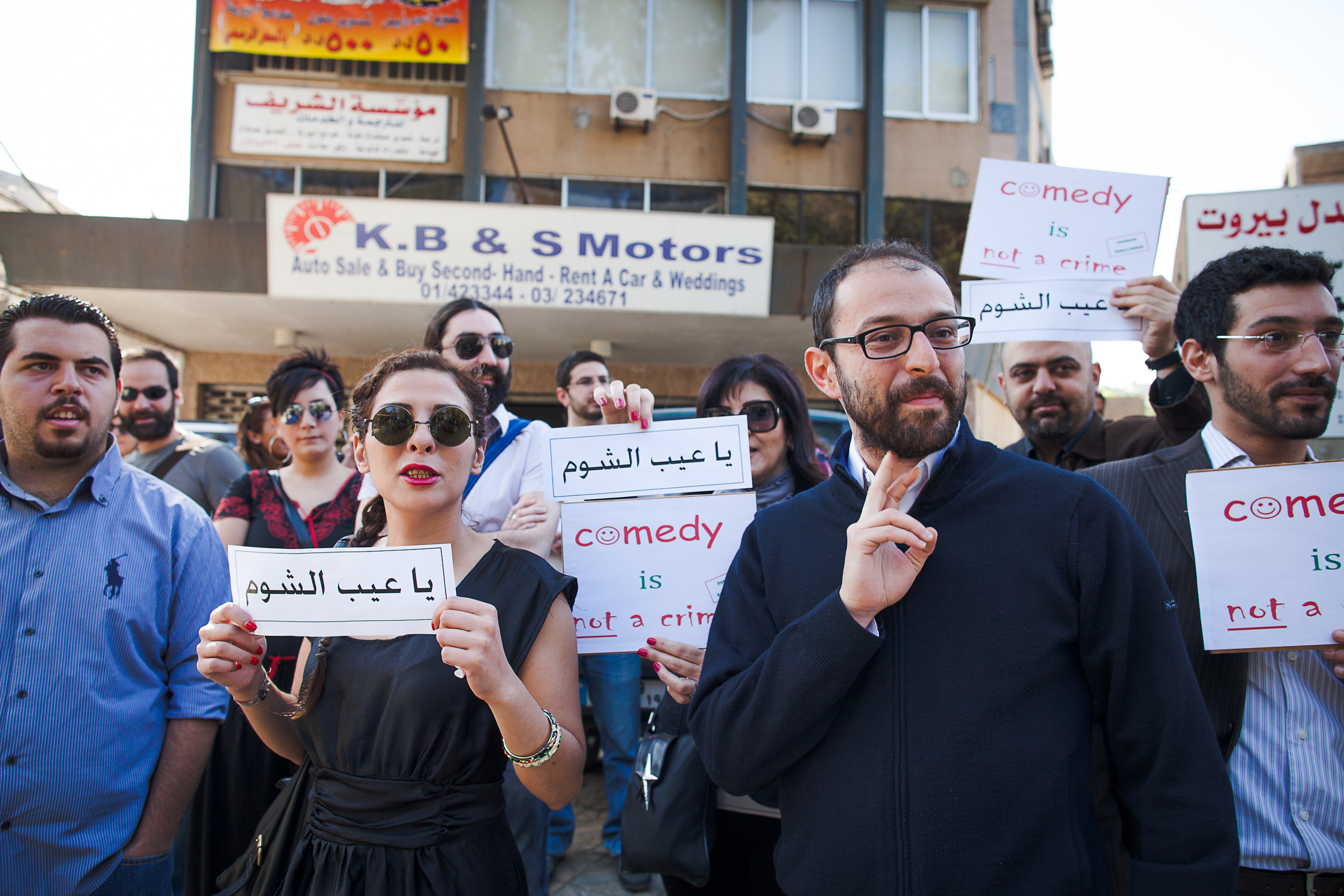
No one was laughing outside the courthouse at the appeals hearing (Photo: Executive/Sam Tarling)

It is the proper application of law that separates anarchy from order, suppression from representation, people from slaves and fosters a society with a respect for the structures of governance. The opposite is just as true, where it is the selective application of law — for example when charges are conjured up to suppress freedom of expression in the name of preserving ‘public morality’ — that leads to the destruction of faith in the institution of law itself. As citizens’ distrust of their government mounts, the social contract between the two becomes less tenable and society breaks down. This is where Lebanon is today.

Following a recent string of arrests related to freedom of expression, last month actress Rawya el-Chab and comedian Edmund Hedded were in court to appeal a one-month sentence of imprisonment and a fine for committing “acts of offense against public morality”. Their crime: hosting a mock-auction of men at a pub in 2009 in order to raise money for the Brave Heart Foundation, which helps children with heart diseases.

The General Prosecutor’s office dug deep through the Penal Code to find a way to invoke paragraphs two and three of Article 532 which cover, respectively, “words or screams that have been manifested by a person and heard by a party that has nothing to do with the act,” and “visuals presented in a public context or for a public or in exhibition or broadcasted or sold or distributed to one or more persons.”

While Parliament’s library (yes, it does exist) is stacked with unapplied laws relating to the most basic functions of the state and serving the public — such as passing a budget, providing public services (electricity, water, telecoms) and ensuring human rights (among them the law against child abuse) — our justice system found the time to apply its energies and resources to exercise obscure laws to subdue free speech.

But to think that the judiciary all of a sudden has the intent to weed out villainous threats to virtue and goodness would be a laughable assertion. Aside from the absurdity of a subjective concept such as ‘morality’ existing in a piece of law, an hour of local television will provide one with more than a dose of ‘immoral’ words and screams and the visuals to go with it, especially if one watched Parliament last month. Fortunately for them, our MPs can hide behind their legal immunity; we cannot.  And, as if there were not more pressing issues in the country, those who claim to defend freedom of expression — journalists from El Nashra and Annahar —provoked the judiciary by writing articles critical of the mock-auction. Indeed, the judge who sentenced the comic duo did so largely on the basis of these media articles. At the Appeals Court last month it was clear that the judge had no clue what the case was about and, worse still, after expelling the public from the courtroom, cross-examined the accused and the prosecutor, without allowing the defending lawyer to be heard; that will only happen on May 30.

This is no laughing matter. If the General Prosecutor can convict someone for violating some backwards piece of legislation on the basis of an article, and without an investigation, then a harrowing precedent has already been set.

Furthermore, what faith should the public have that the judiciary has any sense of ‘justice’ about it? Or that the laws passed by our government have as their intent any sort of proper governance?

What are meant to be the sacred words of our social covenant, also known as the constitution, have been defiled by the very people who are supposed to uphold them. We, the people, are not “sovereign, free, and independent,” the people are not “the source of authority and sovereignty,” the political system is not “established on the principle of separation, balance, and cooperation amongst the various branches of government.” Instead, imbeciles and their whims are given authority over our freedom of speech.

If they wish to begin winning back the faith of the people they have so often betrayed rather than served, it is incumbent on our judiciary to see to it that these sentences are repealed, the charges dropped, and spare us their selective morality.

This article was first published in Executives’s May 2012 print edition

An unsavory policy

The Lebanese will be stuck with rotting food in their stomachs unless policy makers finally put people over politics (Photo: Sam Tarling)

The slew of food safety incidents that have hit the national news ealier this month, following the discovery of tons of rotting meat in a Sabra factory, do not constitute a new “crisis” — rather, they are the revelation of a reality that has long been present. The spike in public awareness, and consequent flurry of government activity, has simply made salient some uncomfortable truths that have long been with us.

Even in the most advanced societies, food safety is one of the most complex and challenging policy issues facing government. Just last year nearly 50 people died in France and Germany after contaminated seeds from Egypt ostensibly caused an outbreak of E. Coli bacteria. That was a crisis. And that the combined policy framework of both countries’ food safety authorities, and that of the European Union, were unable to contain the outbreak before it turned lethal is a wake up call we should heed.

Many may wonder why similar incidents haven not emerge in Lebanon, given that our policy framework is written based on the demands of sectarian staffing quotas rather than public health. Some have, tongue-in-cheek, alluded to the inherent Lebanese ‘tolerance’ to contamination. In reality, luck coupled with a lack of transparency and awareness, are what have allowed us to ignore the issue for so long.

Food safety policy can be either reactive or active — but Lebanon’s is neither. Reactive food safety entails tracking a case of contamination from an ill patient to the source, and requires an intricate investigation of the patient’s food consumption, tracking down each source of possible contamination, having the authority to confiscate and test samples, and establishing viable evidence to persecute violators. In Lebanon what happens, more often than not, is that the patient is tended to, the government and hospitals circumvent the lengthy and expensive process of investigation, the issue is ignored and the extent of the problem is covered up.

Active food safety policy, on the other hand, requires ensuring that local production and imports are up to scratch by conducting snap inspections, covert investigations, treating irrigation water, conducting awareness programs and cracking down on violators. In Lebanon, however, limited authority, resources and overlapping purviews hobble inspections by health ministry and consumer protection agency officials.

Food safety policy must be adopted ‘farm to fork’, but there is currently no single authority to oversee such an approach. The agriculture ministry is responsible for testing farming practices (such as the widespread use of wastewater for irrigation) and conducting inspections at import entry points, in conjunction with the ministry of economy and trade and the health ministry. The health ministry compiles statistics and coordinates with the interior ministry, which, in theory, raids warehouses containing contaminated products. The Ministry of Energy and Water is supposed to see to it that contaminated water does not reach farmers, while the ministry of transport should oversee transportation storage. And, in the end, the finance ministry has to agree pay for everything, whether there is a budget or not.

Of course, none of these ministries are eager to give up their authority to a centralized food safety authority, which was first proposed in a draft law years ago, but has spent most of time since collecting dust on parliamentary shelves. The last time it was discussed at the cabinet table was in 2011 — the agriculture minister objected to it and, after a public outcry, struck a deal with the prime minister that any new food safety law would not dilute his authority.

To his credit, the agriculture minister has been one of the most proactive players regarding food safety. But the agriculture ministry has for decades been under the purview of either Hezbollah or Amal, both of whom rely on their constituency of southern farmers for political support and to hold territory along the border from which to resist Israel when war comes calling. Thus, diluting the ministry’s authority is tantamount to compromising national security in the minds of the South’s political patrons. But political calculations should not trump public health.

Any new food safety authority would need the support and cooperation of the agriculture ministry to be effective. But before reaching that step, a new food safety law needs to be passed by parliament and the cabinet needs to find and appoint five qualified board members from different sects. What real prerogatives the authority would eventually have would be the differentiating factor between reform that actually works or just another toothless government body.

For a country the prides itself on its food, Lebanon has been extremely lucky that its lax food safety has not caused more ill —the needed reforms should happen before the first deadly portions are served at the dinner table.

First published in Executive, March 20 online edition

Driving us mad

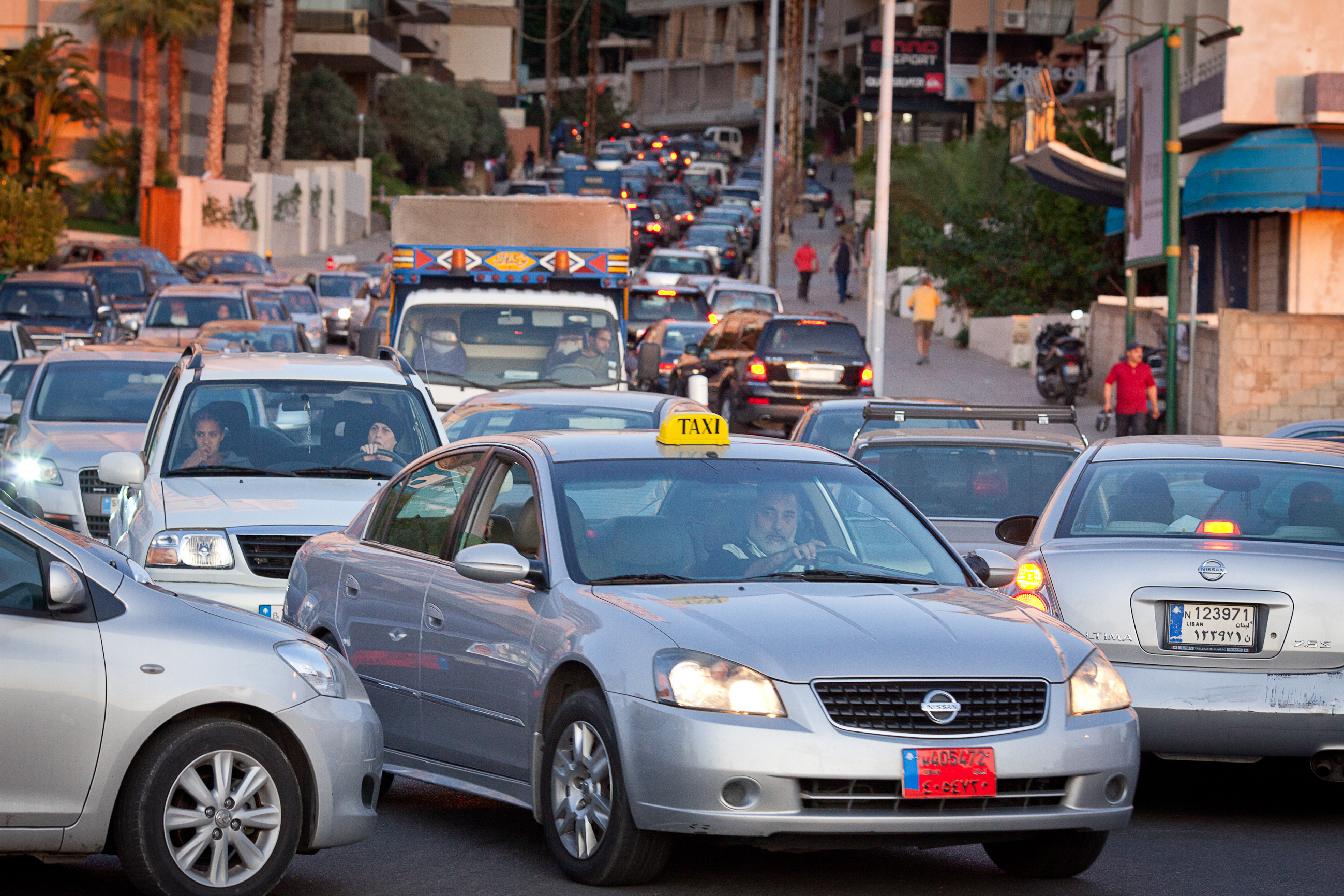
By the time Lebanon passes a budget we will all be driving cabs in traffic (Photo: Sam Tarling)

Inching along amid a cacophony of horns in one of Lebanon’s estimated 1.6 million vehicles leaves a driver with ample time for reflection. As the clock on the dash ticks past another hour and the feet maneuver endlessly from gas to brake, how the country reached this point inevitably comes to mind.

For the sixth year running the country is set to operate without a budget. The president has again broken his oath to uphold the constitution, which states a budget must be passed by the end of January.

This is beyond unfortunate. With a budget comes some sort of policy framework that, in theory, commits the government to put its money where its mouth is. What we have currently is the politically calculated calamity of treasury advances, a crude process where cabinet has to agree on every spending measure outside of the 2005 budget. In any case, hardly any money that came from the people that year, or any subsequent year, comes back to them through the budget. That’s because after the debt servicing is paid to the banks, the deficit of Électricité du Liban is covered and the salaries of the patronage apparatus (also known as the public sector) are paid, the state is already in a deficit.

Any further spending, with borrowed funds, lies solely in the hands of cabinet. In other words, the money borrowed on behalf of the public, that should be spent on the public good, becomes fodder for the overlords pulling the strings at the cabinet table in their petty battles and under-the-table deals. The fact that the funds of $1.2 billion agreed to by cabinet for new power plant construction is to be allocated from the next budget — regardless of how unlikely it is to manifest — and not done through a treasury advance, highlights how little intent exists in cabinet to actually implement reforms.

Thus no one should be surprised when they look out from the windows of their cars to find themselves locked tight in an inescapable labyrinth of metal, given the absence of government policy to reform public transportation. To say that we are approaching tipping point in terms of what our roads can handle would be tardy commentary — we are well past that point. Since our policy makers ceased producing budgetary policy, more than 500,000 cars have entered the country, with the current trend at around 100,000 cars every year. The traffic and the pollution can only get worse.

But traffic aside all these cars are, quite literally, starting to drive the economy and an increasing proportion of the job market. Already the value of the car imports totals some 4 percent of gross domestic product, which doesn’t help much given that this is money leaving the country, not staying in it to create employment. Then consider all the customs and fees, which account for another 4 percent of GDP, which people must pay to a government that does little for them in return.  And since the years of economic growth were “jobless,” in the words of the last finance minister, many local private sector jobs are now being steered by those very same cars.

Figures relating to how many people are directly and indirectly employed in the automotive sector are sketchy, not least because a national labor survey has never been conducted. But the sprawl of the ‘car economy’ can easily be seen with just a glance at the countless mechanics in Goberi, Sarafand or on the road to Halba, or the armies of valet parking attendants and cabs in the capital.

With labor-intensive sectors such as agriculture in decline and the trade or services having a small labor component, the options left for gainful employment are hardly the professions that will produce a society that progresses beyond being passive consumers of imports, or one that has the political and economic infrastructure to build anything else. The longer we go without a shift in the financial dictates that rule the country, the more our job market and our economy will be skewed toward import-based sectors, rather than creating one that can compete productively on an international level.

Unless our financial policy makes an abrupt U-turn, we will continue to be driven mad by our politicians and, perhaps deservedly, ourselves.

First published in Executive, March 2012 print edition

The ugly side of man

The women of Lebanon are still left waiting out in the rain for their rights (Photo: Hisham Ashkar)

Misogyny is the vulgar indulgence of ignorant men, and it is a shame upon this nation that the men who head our government so openly display this flaccid form of intellect. They began to give it expression early in their term, by forming a cabinet devoid of women, and continued through their denial of nationality rights to the children of Lebanese women and their spouses, then ignored a parliamentary initiative to enact laws targeting men who beat their wives and, more recently, a refusal to criminalize marital rape — these are just some of the more obvious affronts.

With such exemplary leaders, it is no wonder why the slighting of women is so pervasive in our society, reaching even inside their bodies to reproductive choices.

Even though abortion is widely available in Lebanon, it remains technically illegal and therefore unregulated and often unsafe. While forms of emergency contraception, in particular what is commonly known as the ‘morning after pill’, are not officially barred, pharmacies across the country were not stocking it on their shelves through December and January.

Emergency contraception in the form of a pill does not induce an abortion; it is a preventative measure that releases hormones to prevent fertilization during the time it takes sperm to reach the egg, usually between 24 and 72 hours after intercourse. Only one brand of emergency contraception, called Norlevo, has legal access to the Lebanese market, but for reasons unbeknownst supplies of the drug were “cut off” according to the more than 20 pharmacies that were contacted last month.

Calls to the local distributor, Union Pharmaceutique d’Orient, enquiring as to why, were met with denials that there was even a shortage and officials for the company refused to comment further. The manufacturer in France, HRA Pharma, also declined to comment. The head of the Syndicate of Pharmacists in Lebanon said he was unaware of the issue when asked, but promised to follow up on the matter — all further calls to his phone were left unreturned.

The underlying issue here is that there are no consequences for private companies who take away a woman’s right to choose and even put their lives at risk. The worst thing that usually happens with the morning after pill is a horrible mood swing, but little or no pain. But the alternative to proper emergency contraception for, say a 16-year-old girl who has been raped, is resorting to drugs such as Misoprostol, intended for use in the prevention of ulcers, but also having the ‘side effect’ of technically inducing miscarriage.

So instead of a relatively painless hormonal procedure to prevent pregnancy, women are forced to endure an excruciating process whereby eggs are expelled after contractions in a pool of blood and then, “you just pray,” according to one pharmacist, that fertilization has not taken place. There is no guarantee with Misoprostol that an embryo is expelled, as it is possible that a life threatening ectopic pregnancy might occur, where the embryo implants outside the uterus. Other complications of Misoprostol can include potentially fatal toxic shock syndrome.

This shortage of Norlevo on the market is directly related to Lebanon’s economic aberration of exclusive agents, which disallows any other company from importing the same brand of medicine. So, in the interests of companies’ product monopolies that keep retail prices high, and the structure of our economy dependent on a few rich and powerful men, women are suffering.

Reproductive rights, and the recognition that women are entitled to the same opportunities and protections as men in a society, are not trivial policy matters — they are issues of human rights that leaders with any claim to morality need to address.

Misogyny in Lebanon is as societal as it is systemic, rooted in a lack of education with regards to the issues and perpetuated by regressive laws and lawmakers. For the sake of treating half the population — including our sisters, wives, mothers and daughters — with a minimum of respect, we cannot allow our leaders to sit so comfortably with their inhumanity.

First published in Executive Magazine’s February 2011 issue